Recommendation


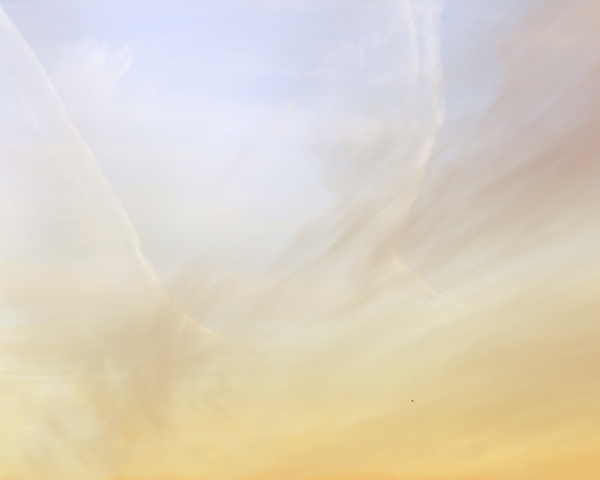
Untitled (Reaper Drone) by Trevor Paglen

In his first domestic solo exhibition since winning a SECA award in 2009 (on view at Altman Siegel Gallery through April 2, 2011), Bay Area photographer Trevor Paglen ups the aesthetic ante while maintaining his edge. Paglen is known for documenting secret military and intelligence surveillance operations; he is interested in how machines that “see,” be they cameras, drones, or satellites, impact our world and how we move through it. This show is no different and so shares with previous work a sense of intrigue. We get to spy on things that are supposed to be hidden. These new works also feature a more developed poetic beauty.

A group of three large-format (two 48 x 60 inches, the other 60 x 48 inches) untitled photographs featuring a Reaper Drone against a huge sky are reminiscent of Rothko color-field paintings. They are luminous and subtle, the drone almost lost in the vast skyscape.

Also taking on a painterly quality is the glowing image, They Watch the Moon, and the whiteish-orange-red blurry abstraction The Fence. The former is a long-exposure image of a “listening station” in West Virginia taken on a night of the full moon; a glowing, golden city in a hazy green atmosphere. The Fence shows the radar system that surrounds the U.S., the frequencies having been brought into a visible spectrum.

An eight-image sequence of a Predator Drone flying, titled Time Study, is a nod to the motion images of Eadweard Muybridge. Paglen even goes so far as to develop his photos just as Muybridge did, using the albumen method, which gives them a yellowed, aged look. And like the images of his inspiration, Paglen’s explore ideas of vision, time, and place–a common theme throughout the show–capturing what we can’t see with the naked eye. But here things get a bit more serious; these are highly advanced systems for warfare.
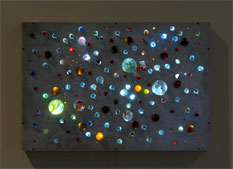
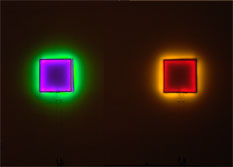
"Constellation #1" by Cork Marcheschi

Inside the darkened gallery space is a calming, colorful array of work by Bay Area–based Cork Marcheschi, all aglow. This exhibition, “Cabinet of Curiosities” (on view through February 26) is a mini-retrospective for the artist, who has been working in the medium of light since 1968. Many of the works are recent or current (2009–2011); they are interspersed with pieces going back to 1969. Along the way, we see clear shifts in style and interest as Marcheschi investigated the breadth of his chosen medium.
None of the pieces flash or move — at least not without human interaction. The 1975 Oasis creates a sizzling electrical current when a pedal is pushed, and Jujubees (1970–1990) gently reacts to touch with increasing intensity of light. The overall effect is quiet and meditative; it comes as no surprise that the artist is a longtime practitioner of Zen Buddhism, which he studied under Alan Watts.
Several current works utilize colored marbles fit snugly in holes cut out of an aluminum box; the light from inside the box shines through the marbles to create a soft glow. With titles such as Position of the Stars the Night Lenny Bruce Died (2010) and Constellation #1 (2009), there are clear references to starry skies, which several of these works resemble. The use of marbles evokes memories of childhood.

"Mantle Paratrooper's Last Jump, Goodbye Uncle Buddy" (13 and 14) by Cork Marcheschi

Light is also used to commemorate those who have passed. Two of the most recent pieces are memorials to the artist’s dog Ruby. Blues for Max (1992), a child’s chair that stands on lightbulbs to produce a ghostly glow, as well as the two neon squares, Mantle Paratrooper’s Last Jump: Goodbye Uncle Buddy, 13 and 14 (both 1980) commemorate people now deceased.
Marcheschi’s style has ranged from color-casting minimalist geometric neon work that calls to mind Dan Flavin, to complex, funky and funny pieces. The latter label fits a work of backlit steel that has been plasma cut with lively cartoony images whose shadows dance chaotically on the wall, recalling William T. Wiley and H. C. Westermann. Such references there may be, but this is an artist who, ultimately, is doing his own thing. That thing is by turns playful, sad, inspirational, and peaceful. Light can do all that.

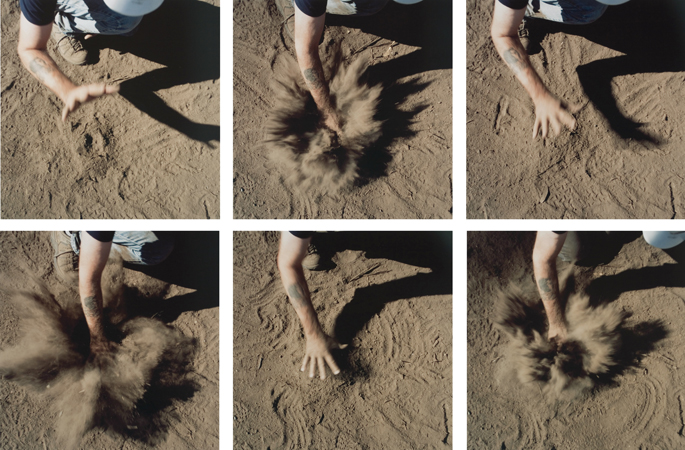
Andy Goldsworthy's "Hand hit site dust," Presidio Spire, October 2008

Using only materials found as is in nature — rocks, dirt, water, flowers, branches — Andy Goldsworthy (whose exhibition Incidental Objects is on show at Haines Gallery, SF, through December 24) creates quietly beautiful installation works. Goldsworthy has executed over 120 commissioned works the world over, several of which are located in the Bay Area, including the cracked stone piece, Drawn Stone, which traces the entrance to the de Young Museum, Spire in the Presidio, River of Stone at Stanford, and Surface Tension at the Hess Art Museum. Typical of the Scottish artist’s work, these feel so right, so effortless, poignant and poetic. What isn’t evident is the complex conceptual and experimental considerations leading up to these elegant final products.

This current exhibition provides insight into Goldsworthy’s explorations; it includes documentation — photos, works on paper, proposal drawings, and video — of the “incidental” and often temporary creations resulting from Goldsworthy’s process. Images of a hand smacking the dusty ground in the Presidio at the site of Spire address his process and stand apart from the final rather architectural image. Video documenting the creation of Rain Shadows, for which the artist laid on the ground through rainstorms; in the end, the form of his body remains in the dry dirt. These action maquettes and other artistic residues bring a greater understanding to the longer lasting final product. But they also illuminate, as anyone who’s seen the 2001 documentary Rivers and Tides — which follows Goldsworthy through many artistic adventures — that this artist creates graceful traces, however impermanent, all along the way. It’s a selection that not only reveals Goldsworthy’s path of contemplation, but is a fine example of ephemera that succeeds as works of art in their own right.

"Glimmer" by Will Rogan

Will Rogan presents quietly intricate photographs and sculpture that continue his pursuit of finding the extraordinary in his everyday urban surroundings in his solo exhibition at Altman Siegel Gallery (through November 6, 2010). This provides him a path by which he explores themes of time, impermanence, relationships, and fragility. Similar visual elements also repeat: eyes, light reflected off shiny surfaces, portraits.

Each theme or visual element will pop up in several pieces, but none is present in all of the works. For the viewer, it presents a fun game of “find the similarities” among the different works; they are evident in big ways and small details. In several instances, themes loop over themselves, adding layers and complexity.

Viewing the Past as it Happens, Men Versus Clock: the Unequal Struggle, and The Elusive Nature of Time are each a photograph of a spread from a book about time; the titles of the works are the topic that is covered in the spread. The book itself is clearly dated. It has become a victim of the topic it addresses. The photographs themselves document a moment, which immediately becomes the past. They can never capture the present because as soon as they do, it is gone. Nothing is permanent.

Impermanence is also present in Can and Glimmer. Each image features an instant of the sun hitting a reflective surface – an aluminum can in the former; a piece of broken mirror in the latter – providing a flash of brightness in an otherwise dull and ugly landscape. These are two more examples of Rogan highlighting something “fantastic,” however brief, where otherwise we would see only decay.

Rogan has that wonderful ability to create work that is both complicated – there’s so much going on it can make your brain hurt, or alternatively jump for joy – as well as peacefully evocative. At times images are downright elegant and beautiful. When drawing our attention to a googly eye reflected in a mirror in The Floor, he also permits that serious are can be quite playful.

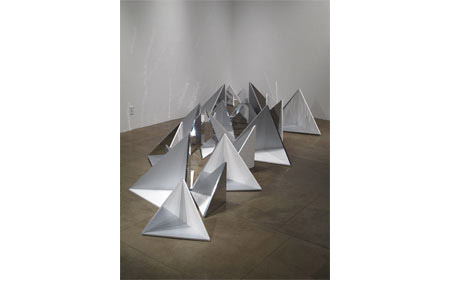
"Pitch" by Timothy Nolan

In his solo exhibition at Marx & Zavattero (on view through August 21, 2010), Los Angeles-based artist Timothy Nolan delivers contemplative sculpture that is all clean geometric forms, a subtle palate of silver, black, gray, and white, and various surface treatments – mirrored, reflective, flat. Nolan continues his investigation of patterns, repetition, and systems, both made and natural. The work easily draws the viewer into the complexity encompassed, including the exploration of visual perception and construction of illusory versus real space.

Evident throughout is the influence of minimalism and cubism; the artist is also inspired by craft and op art. The exhibition features floor and wall sculpture as well as works of silver metallic paper on panel and other two-dimensional pieces. The centerpiece – both literally, as it takes up a large space within the gallery, and figuratively; it’s enchanting – is the twenty-foot-long Pitch. Comprising more than twenty triangular pieces of various sizes, with several of the surfaces mirrored and reflecting off of each other, the work evolves into endless shards and crystalline structures, elegantly getting to the heart of Nolan’s interests. In the wall sculpture, “Stack” – which is also made up of a series of over twenty non-identical hard-edged shapes, these composed of printed vinyl on aluminum – geometric shapes in five gray-scale hues also play with our comprehension of light and shadow and the shaping of space; the piece appears to be more three-dimensional than its flat surfaces really are.

While Nolan’s artwork overall is hard-edged and calculated in appearance, it’s not cold. This is meditative work that we not only see but experience.

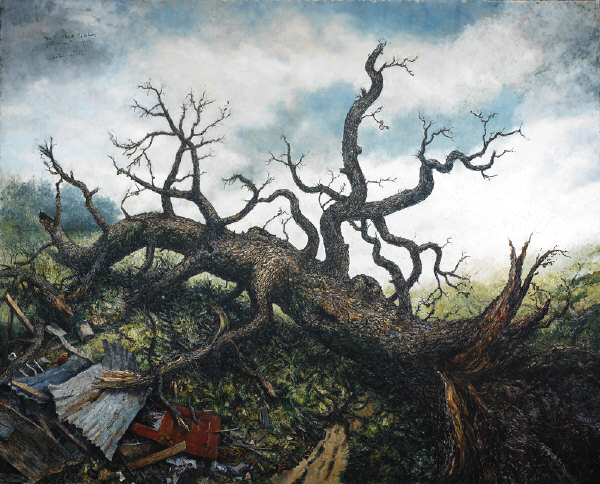
"The Crooked Timber" by Chester Arnold

Chester Arnold’s paintings and drawings (here, studies of the larger oils on linen) are alive. Cliffs, fallen trees, piles of branches, and tree stumps pulse with personality, in this new body of works that are almost devoid of people. As he has in the past, Arnold based this series on a central theme, one of the artist’s favorite quotes, which was penned by the German philosopher Immanuel Kant: “From the crooked timber of humanity, nothing straight is ever made.”

In this exhibition, titled “The Crooked Timber and other paintings and drawings” and on view through July 3, Arnold continues to explore the intersection of man in nature in highly detailed and expertly stylized nature scenes. The wind’s chaos kicks up papers, deterioration, detritus, cut-down trees. In several works, the Sonoma-based artist also keeps the slightly elevated perspective found in previous paintings; the viewer surveys the scene from above. But these studies of decay, based as they are on such a doom-and-gloom declaration, do not depress. In these often large scale landscapes (several measure as large as 78 by 96 inches) are touches of humor; Arnold’s jaunty, fluid Van Gogh-like strokes result in an animated playfulness. There’s also an earthy, romantic appeal of times past–the allure of an abandoned old barn or rickety rope-and-wood-plank bridge. One comes away with a sense of optimism or hope: there’s a beauty and substance of character to be found among the gnarled wreckage.
This recommendation originally appeared on Visual Art Source.

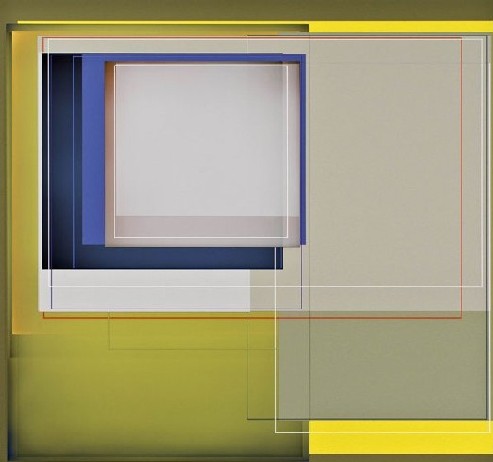
"From Above" by Patrick Wilson

Since the point of this weekly selection is to pick one work of art to highlight, I forced myself to choose from the numerous outstanding paintings featured in Patrick Wilson’s solo exhibition, “The View From My Deck,” currently on view (but only until June 5, so get in to see it now!) at Marx & Zavattero. I’m always astonished by artists who can take something as simple as four-corner shapes and their outlines, and layers of color and, again and again, create exquisitely sublime art. I chose From Above for its subtle boldness, gentle resonance, and bravery (let’s face it: it’s an accomplishment to make sickly greenish yellow  and grey tones so appealing), but I’d happily rehang this entire show where I live; these are works that keep giving.

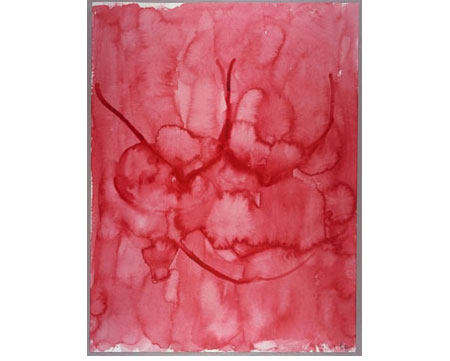
Louise Bourgeois's "The Feeding"

The vast ouvre of internationally recognized and legendary artist Louise Bourgeois, now 98, has always been personal, often autobiographical. The artist has also worked in a wide variety of media. This show of newer work at Gallery Paule Anglim, titled “Mother and Child” (on view through June 12), features both aspects. On view are sculptures, verse, gouache drawings, and prints focused on motherhood, sexuality, birthing, the female power to create, aging, and dying. With these, then, Bourgeois also continues her career-long attention to the experience of being a housewife/mother, further establishing her as one of our most important feminist artists.

Bourgeouis’s work can tilt towards heavy-handedness, particularly when it engages in overly literal, sometimes gruesome, dipictions of pain and fear. That is not a problem here; in fact, quite the opposite.

The gems of the show are the thirteen gouache drawings. This is particularly interesting given the imagery – graphic birthing scenes and nudes of pregnant women that depict the fetus in utero – and the fact that they are all painted in blood red on a flat white background. Crudely painted to the point of being almost abstract, with edges blurred by the watery gouache, they are approachable and, somehow, sad. They reveal themselves slowly; from the forms emerge a baby’s head from between two legs, and oversized breasts. These are solitary women, swollen and alone. Slightly more abstract, and quiet, are the two medium-size bronze sculptures. From Bourgeois’s “Echo” series, these are casts of sweaters that had been soaked and stuffed; they’re both painted white. Hinting at the human figure, the sagging, drooping forms poetically speak to emptiness, aging, and death.

Intimate, shocking, scary, viseral, beautiful, Bourgeois here succeeds as only someone with years of experience at her craft and art, and a long life of intense and moving experiences fully felt, is able. She gets to you where it counts.

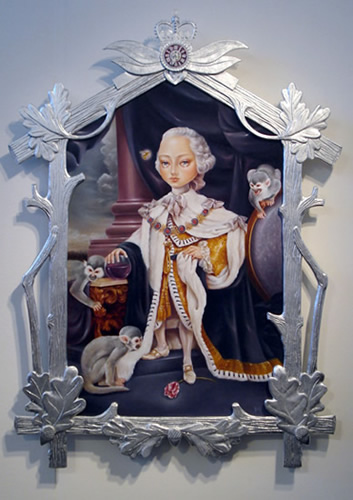
David Michael Smith's "King George III"

 
From the moment I first saw SF-based artist David Michael Smith‘s work at Scott Richards Contemporary Art a month or so ago, I was smitten. I had the chance to see this latest creation, King George III, at the SF Fine Art Fair, and I liked it so well that I was inspired to create this new section so I could talk about it: my pick of the week.
Smith draws on historic personalities, pop culture, and symbolism to add rich (often creepy or dark) narrative to his beautifully rendered, almost surreal paintings. Note, for this work, he also made the frame and constructed the clock.
Here is Smith’s full description of this painting as stated on gallery Website: This painting depicts King George III, the third British monarch from the House of Hanover. By all accounts a well-intentioned, pious, and judicious king, he suffered in later life from recurrent and, eventually, permanent mental illness. This is generally supposed to have been the result of the blood disease porphyria.
One of the symptoms of porphyria is a purple discoloration of urine during an attack. The painting is saturated with the color purple and the glass bowl under his right hand is full of a purple liquid. The pillar behind him is made of porphyry (derived from the same Greek word, meaning “purple pigment,” from which the disease is named) as is the clock face set into the frame. I’ve included symbols of madness in the painting including a hornet and a tulip and the looming storm on the horizon.
King George III kept a menagerie of exotic animals at Kew Gardens and I’ve included the monkeys as a reference to them. As his life became more and more wretched due to his illness, he lived much of his later years as a prisoner in Windsor Castle, subjected to the harsh treatment of various doctors. I imagine he could have felt quite a kinship with these creatures, ripped from the normalcy of their lives and put behind bars.

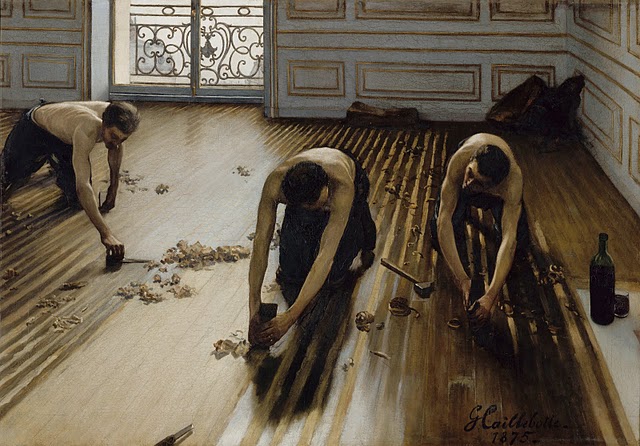
Gustave Caillebotte's "The Floor Scrapers"

Sit with this for a moment: beginning this late spring through January 2011, over two hundred iconic French Impressionist, Postimpressionist, Realist, and Naturalist paintings will be on show at San Francisco’s de Young Museum. And these works will never be seen again in such quantity outside of their home, the Musée d’Orsay in Paris.
Opening May 22 (and running through September 6) is “Birth of Impressionism,” which will feature about half the works and focus on Paris around 1874, when the first exhibition of Impressionist paintings took place. “There was a preponderance of different styles,” says  Director of the Fine Arts Museums of San Francisco John Buchanan, “all at once and all in one city.”
Almost immediately following (opening September 25 and running through January 18, 2011) is the exhibition “Van Gogh, Gauguin, Cezanne, and Beyond,” featuring Postimpression-ist work by the greatest masters of the genre. The de Young is the only venue in the world to get both shows.
How’d we get so lucky? It’s all about passion and good relationships. But first some background. The Musée d’Orsay is home to the world’s most comprehensive collection of nineteenth century French art, including Impressionist and Postimpressionist work, by design. Housed in what was originally a train station (note: the architect who transformed it into the museum, the renowned Gae Aulenti, is also responsible for San Francisco’s Asian Art Museum), created in 1900 for the Paris International Exhibition, the museum was launched in 1986. Its mission is to highlight Western art from 1848 to 1914. Its collection was formed by consolidating the best pieces from this period from the Louvre, Jeu de Paume, and the Modern Art Museum in Paris, as well as generous gifts from private parties. Many of the works coming to San Francisco were originally in the collection of Gustave Caillebotte; a painter himself (his stunning painting The Floor Scrapers will be on show in the first exhibition), he was also a man of great financial means. This allowed him to be an early collector of work by fellow artists. Interestingly as well, several paintings are making a return, having also been shown in San Francisco at the Panama Pacific exhibition of 1915.
In anticipation of its twenty-fifth anniversary next year, the d’Orsay is undergoing a major refurbishment. “The current director, Guy Cogeval, is a professional and personal friend of mine,” says Buchanan. “He asked if I wanted to make an exhibition with him.” Cogeval and Buchanan—who has a great love of nineteenth century French art and culture—met on several occasions to plan the show: two exhibitions emerged. And to that, Buchanan simply said: “I think we should do both.”
Viewers can anticipate what amounts to the rare experience of art history books come to life. The first exhibition highlights works by over forty artists, including such visionary masters as Edgar Degas, Frederic Bazille, Édouard Manet, Claude Monet, Alfred Sisley, Pierre-Auguste Renoir, and Gustav Courbet. Highlights include: Degas’s The Dancing Lesson (1873–1876) and Racehorses Before the Stands (1866–1868), Monet’s Saint-Lazare Station (1877) and Rue Montorquei, Paris (1878), and Pierre Puvi de Chavannes’s Young Girls on the Edge of the Sea (1879), among so many others. Buchanan points out that he is particularly excited about the numerous fine Manets that will be here—there will be eleven, ranging from 1865 to 1882. “He was a great Naturalist,” Buchanan says, “yet he was close friends with the Impressionists. His work was influenced by seventeenth century Spanish paintings. He was the first truly modern artist.” Particularly, Buchanan singles out The Fife Player (1866). “We make direct contact with a real human being,” he says of the painting’s subject. “He’s gazing directly at us.” Another greatly anticipated work is what many of us know as “Whistler’s Mother,” American expatriate James Abbott McNeill Whistler’s Arrangement in Gray and Black, no. 1 (1871). “It shows Realist and Naturalist tendencies,” Buchanan says. “And the influence of Japanese art.”
Running concurrent to “Birth of Impressionism” is “Impressionist Paris: City of Light,” at the de Young’s sister venue, the Legion of Honor (June 5 through September 26). Featuring over 180 prints, photographs, paintings, and books, it will add further context to the main exhibition.
Following, the “Van Gogh, Gauguin, Cezanne, and Beyond” exhibition features 120 works focusing on late Impressionist masterpieces, as well as Pointillist paintings by such masters as Georges Seurat and Paul Signac. Some of what we can look forward to: Vincent van Gogh’s Starry Night over the Rhone (1888), Portrait of the Artist with the Yellow Christ (1889) by Paul Gauguin, and Seurat’s The Circus (1891).
“This is a huge moment for those of us who love France and French art,” Buchanan concludes. “It’s like stepping into an art history book of late nineteenth century France.”

« Previous PageNext Page »

Design a site like this with WordPress.com
Get started