Untitled (Reaper Drone) by Trevor Paglen

In his first domestic solo exhibition since winning a SECA award in 2009 (on view at Altman Siegel Gallery through April 2, 2011), Bay Area photographer Trevor Paglen ups the aesthetic ante while maintaining his edge. Paglen is known for documenting secret military and intelligence surveillance operations; he is interested in how machines that “see,” be they cameras, drones, or satellites, impact our world and how we move through it. This show is no different and so shares with previous work a sense of intrigue. We get to spy on things that are supposed to be hidden. These new works also feature a more developed poetic beauty.

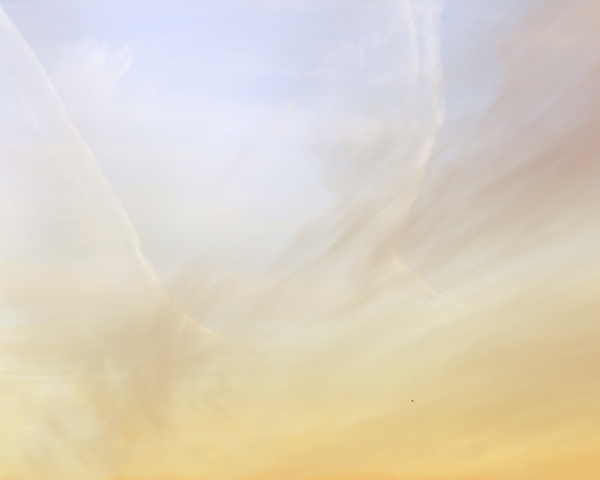
A group of three large-format (two 48 x 60 inches, the other 60 x 48 inches) untitled photographs featuring a Reaper Drone against a huge sky are reminiscent of Rothko color-field paintings. They are luminous and subtle, the drone almost lost in the vast skyscape.

Also taking on a painterly quality is the glowing image, They Watch the Moon, and the whiteish-orange-red blurry abstraction The Fence. The former is a long-exposure image of a “listening station” in West Virginia taken on a night of the full moon; a glowing, golden city in a hazy green atmosphere. The Fence shows the radar system that surrounds the U.S., the frequencies having been brought into a visible spectrum.

An eight-image sequence of a Predator Drone flying, titled Time Study, is a nod to the motion images of Eadweard Muybridge. Paglen even goes so far as to develop his photos just as Muybridge did, using the albumen method, which gives them a yellowed, aged look. And like the images of his inspiration, Paglen’s explore ideas of vision, time, and place–a common theme throughout the show–capturing what we can’t see with the naked eye. But here things get a bit more serious; these are highly advanced systems for warfare.

"Constellation #1" by Cork Marcheschi

Inside the darkened gallery space is a calming, colorful array of work by Bay Area–based Cork Marcheschi, all aglow. This exhibition, “Cabinet of Curiosities” (on view through February 26) is a mini-retrospective for the artist, who has been working in the medium of light since 1968. Many of the works are recent or current (2009–2011); they are interspersed with pieces going back to 1969. Along the way, we see clear shifts in style and interest as Marcheschi investigated the breadth of his chosen medium.
None of the pieces flash or move — at least not without human interaction. The 1975 Oasis creates a sizzling electrical current when a pedal is pushed, and Jujubees (1970–1990) gently reacts to touch with increasing intensity of light. The overall effect is quiet and meditative; it comes as no surprise that the artist is a longtime practitioner of Zen Buddhism, which he studied under Alan Watts.
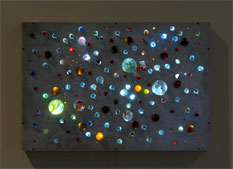
Several current works utilize colored marbles fit snugly in holes cut out of an aluminum box; the light from inside the box shines through the marbles to create a soft glow. With titles such as Position of the Stars the Night Lenny Bruce Died (2010) and Constellation #1 (2009), there are clear references to starry skies, which several of these works resemble. The use of marbles evokes memories of childhood.

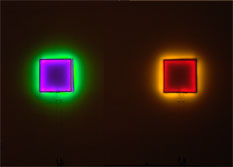
"Mantle Paratrooper's Last Jump, Goodbye Uncle Buddy" (13 and 14) by Cork Marcheschi

Light is also used to commemorate those who have passed. Two of the most recent pieces are memorials to the artist’s dog Ruby. Blues for Max (1992), a child’s chair that stands on lightbulbs to produce a ghostly glow, as well as the two neon squares, Mantle Paratrooper’s Last Jump: Goodbye Uncle Buddy, 13 and 14 (both 1980) commemorate people now deceased.
Marcheschi’s style has ranged from color-casting minimalist geometric neon work that calls to mind Dan Flavin, to complex, funky and funny pieces. The latter label fits a work of backlit steel that has been plasma cut with lively cartoony images whose shadows dance chaotically on the wall, recalling William T. Wiley and H. C. Westermann. Such references there may be, but this is an artist who, ultimately, is doing his own thing. That thing is by turns playful, sad, inspirational, and peaceful. Light can do all that.

The immediate impression of “EINFLUSS: 8 from Düsseldorf” (on view through February 5, 2011) is, wow, these artists can paint! Save the two works by artist Luka Fineisen, a sculpture and a gestural wall piece, both made with plastics, all of the other twenty-seven, mostly large-scale works in the exhibition are paintings, and there’s something wonderful to be found in every one of them.

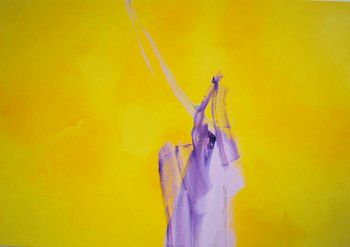
Bernard Lokai, "Ohne Titel"

As the show’s title indicates, eight artists are represented: Bernard Lokai, Jutta Haeckel, Driss Ouadahi, Birgit Jensen, Cornelius Völker, Stefan Kürten, Stefan Ettlinger, and Fineisen. The artists all studied at the Kunstakademie in Düsseldorf, well known as one of the most influential art schools in the world. The list of artists who have studied or taught there reads like an A-list of contemporary art: Gerhard Richter, Joseph Beuys, Bernd and Hilla Becher, Andreas Gursky, Thomas Struth, Katharina Fritsch, Anselm Kiefer, and Sigmar Polke, to name only a handful. And if there’s a singular thread to be noticed throughout the work of all artists who have ties to Kunstakademie, including the eight in this show, it’s a rigorous training in both art history and formal artistic pursuits.


Stepping into the gallery, you are immediately grabbed by Lokai’s bright abstract work, “Ohne Titel.” The painting features a bold yellow background that subtly varies in intensity and purple/lavender brushstrokes concentrated in a tall, rather thin triangular form with its base at bottom mid-canvas and the apex ending about three-fourths of the way up, a light gesture that veers off the top of the picture. It is a work of economic movement and elegance. Lokai’s two additional works in the show — to be fair, one of the pieces, “Landschaftsblock S (Landscape Block S),” is actually comprised of eighteen small canvases, each a study in the exploration of that space between representation and total abstraction — are equally engaging. Evident is the influence, though not overbearingly so, of Richter, under whom Lokai studied.

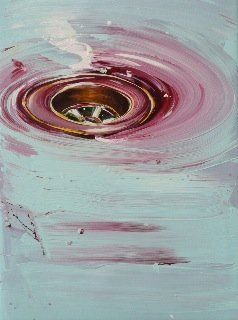
Cornelius Völker, "Sink - 4"

Exhibiting a love of paint’s lusciousness is Völker, whose two paintings of sink drains and six guinea-pig works — Völker works in series, fully immersing himself in whatever he’s focused his brush on — are as much about their subjects as they are about celebrating the medium. Thick, brushy strokes blend and swish the color about. The drains swirl with life, the guinea pigs become almost abstractions of delightfully colorful, moppy hair.


Ouadahi combines a strong sense of architecture with emotion. In “Vis à vis,” layers of beautifully painted grids may be read as outlines of high-rises being built, or the aftermath of destruction. The viewing experience sets you apart from the city. A barrier is also present in “Fences Hole,” in which a gorgeous, Impressionist-style dusky sky is obscured by a photorealistic painting of a chain-link fence with a ragged hole in it. There is a sad and lonely feels to these pieces that is only heightened by their beauty.

There are textural, layered pieces by Jutta Haeckel; Birgit Jensen’s explorations of imagery, monuments, and patterns; Stefan Kürten’s nostalgic, historically complex paintings; and Stefan Ettlinger’s livelyl narrative scenes in egg tempura and oil on canvas. Throughout there is attention to process, technique, and individual vision that combine to truly satisfying effect. This is a well-chosen glimpse into what remains one of the most vibrant art scenes in the world.

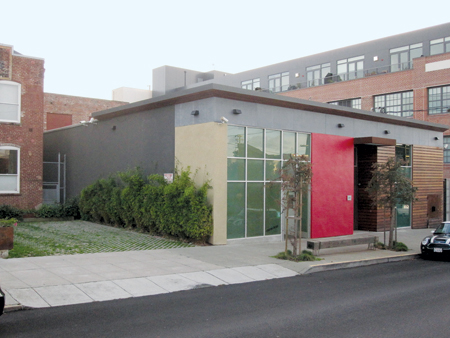
Exterior of Steven Wolf Fine Arts

Where the old warehouses, high-tech lofts, and chic eateries of San Francisco’s Potrero Hill rub up against the gritty streets, ecstatic murals, and colorful Latino and hipster cultures of the Mission District, a burgeoning art scene is coalescing. (Notably, the Mission is also namesake to one of the city’s most recent art movements: the graffiti-/street art-driven Mission School.) Featuring both commercial galleries and new alternative spaces, this emerging arts nexus promises to bring greater visibility to the rich network of San Francisco’s more experimental visual arts talent, as well as to draw in national and international artists and projects.

The Mission/Potrero scene started to simmer visibly in 2006. That year, Eleanor Harwood–who’d been involved in the Bay Area art scene through her work curating the Adobe Books Backroom Gallery–opened her eponymous gallery at Alabama and 25th Streets. Just a few blocks away on 24th Street, Dina Pugh and Joyce Grimm took over operations at Triple Base Gallery, turning it from an organically organized artist space into a community-engaging commercial gallery. Both venues have focused on supporting emerging, often local, artists, many of whom now have strong art careers. (Zoe Crosher, who shows with Hardwood, was invited this fall to participate in the 2010 California Biennial). Also, just down from Triple Base is the forty-year-old Galeria de la Raza, a nonprofit art space focused on supporting Chicano/Latino visual, literary, and media artists. Within just over the last year, these outliers from the San Francisco’s more established downtown scene got a lot more company.

In October 2009, the thirty-six-year-old highly respected and progressive artist-run nonprofit Southern Exposure settled into its new home, a large, open, brick building, on 20th Street. It was followed in the spring of 2010 by Guerrero Gallery and then Gallery Hijinks, both just blocks away. Steven Wolf Fine Arts, which opened in September 2010 across the street from Guerrero, is the most recent addition to the neighborhood. They are all only a short jaunt from the earlier established trio (and all fairly accessible via the city’s BART train).

Guerrero Gallery interior

Each of the galleries offers a little something different. Hijinks focuses exclusively on emerging artists. “We’re only representing artists who are on their way to getting or have never had shows or just need exposure in San Francisco,” explains co-owner Jillian Mackintosh, formerly of the Tenderloin-based White Walls Gallery and then Gallery 6. “This gallery is focused on being a stepping stone into the bigger galleries.” Guerrero–run by Andres Guerrero, founder of White Walls–is also focused on emerging talent, but represents some more established artists as well. Wolf, who relocated from his spot in the premier downtown gallery building, 49 Geary, (his is the only commercial gallery to move to the area from elsewhere in the city) primarily exhibits experimental contemporary work that, as he puts it, “feels original and is hard to pin down, and even when you get a sense of what it’s about, you still marvel that someone thought of it.”

Additionally, he sees the potential to collaborate across disciplines. “Dave Eggers is in the neighborhood, and this is where Litquake [an annual literary festival] is based,” Wolf notes. “There’s this potential for there to be more of a dialogue between the literary world and the visual culture world. That’s another reason why I found this neighborhood so interesting.”

To further enhance the situation, come early March, a trio of art entities will make their home in a space at 20th and Folsom. It will house the object-based art publication The Thing, the People’s Gallery, and Kadist SF. The Thing is moving from a studio to a more public space. Co-creator Jonn Herschend, who runs the project with Will Rogan, notes that, while this new location will primarily serve as the publication’s office space, it will also be open to the public, and events will be hosted there. The People’s Gallery is an associate project of the Independent Curators International–supported People’s Biennial, a two-year traveling exhibition curated by Jens Hoffmann–who is also director of the CCA Wattis Institute for Contemporary Arts–and artist Harrell Fletcher. The focus of the gallery and biennial is on giving exposure to outsider or underexposed artists from across the country. The People’s Gallery will feature bi-monthly solo exhibitions of work by artists featured in the biennial.

And then there’s the multifaceted Kadist, a nonprofit that originated in Paris. This space–run by independent curator and art journalist Joseph del Pesco and Devon Bella, a curator at Adobe Books backroom gallery and curatorial assistant for the 01SJ Biennial–will establish Kadist’s San Francisco presence. This local incarnation will feature a residency for curators, artists, and art publications; art collections, such as its “101 Collection,” a group of contemporary works created by artists who live within close proximity to the West Coast’s Highway 101; and twice-weekly presentations, on Wednesdays and Saturdays. The Wednesday offerings will include screenings, readings, performances, and the like. On Saturdays, the space will be an art magazine reading room stocked with English-language publications from all over the world.

To kick off its establishment, this 20th and Folsom crew plans to host an event on March 9, 2011; details are pending. Meanwhile, the Mission/Potrero art spaces are also coordinating an event for March featuring one-night-only happenings in each location, marking an auspicious beginning for a uniquely inventive–and truly San Francisco–art scene.

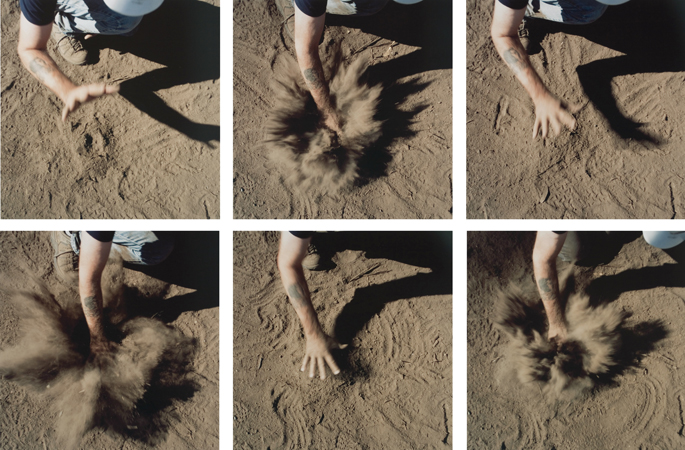
Andy Goldsworthy's "Hand hit site dust," Presidio Spire, October 2008

Using only materials found as is in nature — rocks, dirt, water, flowers, branches — Andy Goldsworthy (whose exhibition Incidental Objects is on show at Haines Gallery, SF, through December 24) creates quietly beautiful installation works. Goldsworthy has executed over 120 commissioned works the world over, several of which are located in the Bay Area, including the cracked stone piece, Drawn Stone, which traces the entrance to the de Young Museum, Spire in the Presidio, River of Stone at Stanford, and Surface Tension at the Hess Art Museum. Typical of the Scottish artist’s work, these feel so right, so effortless, poignant and poetic. What isn’t evident is the complex conceptual and experimental considerations leading up to these elegant final products.

This current exhibition provides insight into Goldsworthy’s explorations; it includes documentation — photos, works on paper, proposal drawings, and video — of the “incidental” and often temporary creations resulting from Goldsworthy’s process. Images of a hand smacking the dusty ground in the Presidio at the site of Spire address his process and stand apart from the final rather architectural image. Video documenting the creation of Rain Shadows, for which the artist laid on the ground through rainstorms; in the end, the form of his body remains in the dry dirt. These action maquettes and other artistic residues bring a greater understanding to the longer lasting final product. But they also illuminate, as anyone who’s seen the 2001 documentary Rivers and Tides — which follows Goldsworthy through many artistic adventures — that this artist creates graceful traces, however impermanent, all along the way. It’s a selection that not only reveals Goldsworthy’s path of contemplation, but is a fine example of ephemera that succeeds as works of art in their own right.

The timely and thought-provoking exhibition Exposed: Voyeurism, Surveillance and the Camera Since 1870 — currently on show at SFMOMA through April 17 next year — explores the use and cultural impact of photography made in public spaces. A thorough examination of a powerful subject, the show inspires us to examine and question how we feel as individuals and a collective about watching and being watched. It also makes clear the huge impact cameras and camera technology has had and continues to have on us.

Exposed is co-organized by SFMOMA and Tate Modern (where it débuted in May), and comprises over two hundred images with works by artists, amateurs, professional journalists, and governmental agencies. The exhibition was conceived by SFMOMA Senior Curator of Photography Sandra S. Phillips and co-curated with Tate Curator of Photography Simon Baker. Just prior to the show’s SFMOMA opening, I did a walk-through with Phillips to gain insight on the show and learn about the stories behind the images.

Chérie Turner: What was the impetus for this show?
Sandra S. Phillips: That’s what everyone wants to know. I did a show a little more than fifteen years ago called Police Pictures, and it’s about the way we think photographs are objective truths, and they’re really not. This idea was the next obvious one — to look and see if the camera has made us see in ways we wouldn’t maybe ordinarily see and what it means culturally for us, too. If there’s a way we look at the world differently because we’re seeing it through a camera lens.

Can you talk about how the show is divided.
There are five sections [The Unseen Photographer, Voyeurism and Desire, Celebrity and the Public Gaze, Witnessing Violence, and Surveillance]. The first [The Unseen Photographer] is really about the beginning notions of what privacy is in public spaces. We are sensitized to having a sense of privacy because photography exploded that and abused it.

In 1870 it was possible suddenly to make a camera small enough that you could conceal it and film fast enough that you could record movement. There were all these amateurs all over the place who were making pictures that were very invasive. The laws said that an American citizen has a right to privacy except in a public space. So that’s why there’s this tradition of street photography, especially in the United States.
So a lot of these pictures here were taken with concealed cameras [several such cameras are on display] — looking at people when they were sleeping or drunk or when they were poor.
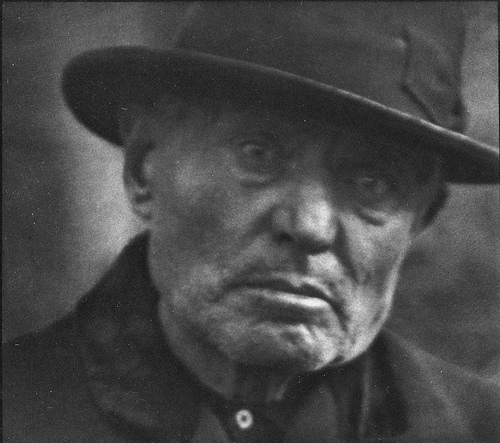
Man, Five Points Square, New York, 1916 by Paul Strand, 1916

This one is one you shouldn’t miss [Man, Five Points Square, New York, 1916]. It was done very early with a box camera that had a false lens on the front and the real lens on the side. It’s an invasive picture. The photographer’s looking at someone’s private anguish. And obviously many of the people in these images are poor–that’s another inegalitarianism.

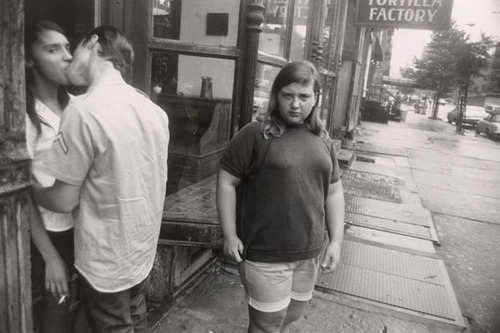
New York by Garry Winogrand, 1969 Collection SFMOMA, fractional and promised gift of Carla Emil and Rich Silverstein; © Estate of Garry Winogrand, courtesy Fraenkel Gallery, San Francisco

This is interesting [New York] because the photographer uses a wide-angle lens, and of course, the couple doesn’t realize they’re being photographed. They think he’s taking just her picture.

nging photos; I’m thinking here about the torture or violence photos in this show as well as the sex images. Can you tell me why they interest you and why you think they’re important for us to look at.
First of all, I don’t think they’re all that difficult. We see most of this on the web all the time. They’re not unusual, they’re just in a different context here. And the reason they’re here is because I want people to think about them. I think they’re very beautiful.

One issue here is, How important in photography is it for the photographer to be an artist? I don’t think it’s important at all. I think the only thing that matters is the picture. And the picture can be taken by a robot or a child or a master photographer. This show is really about ideas as much as it is about pictures. That’s why they’re here. They’re here to be provocative and to promote discussion and thought. There are some creepy pictures, but I think they’re probably creepy because our culture is creepy. Many of these pictures were published in newspapers and magazines. It’s shocking we tolerate it.

We get to face that here, too.
This section [Celebrity and the Public Gaze] is about celebrity and the double-dealingness of celebrity. Celebrities, to be celebrities, need a public, and they need to show their privacy to the public because that’s what the public wants.
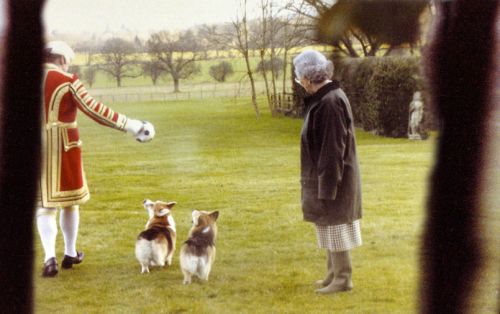
The Queen Plays with her Corgies from the series Confidential by Allison Jackson, 2007 Courtesy the artist and M + B Gallery; © Alison Jackson, courtesy M+B Gallery

These pictures [by Alison Jackson] are completely made up. They’re not real. They’re made with people who look like, say, the Queen.

[Moving on to the Witnessing Violence section.] One thing about this part of the show is that it demonstrates the violence and change in the sixties. There was a lot of sixties trauma that’s depicted that everyone got acclimated to; you saw people getting mangled by dogs and the Vietnam War.

Then we come to the first of the surveillance rooms. We start with history here beginning with the Civil War.
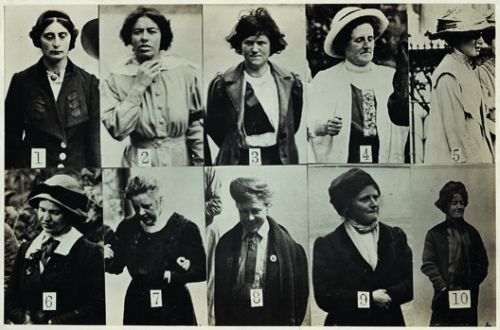
Criminal Record Office, Great Britain, Surveillance Photograph of Militant Suffragettes, ca. 1913 Collection and © National Portrait Gallery, London

Then, here [Surveillance Photograph of Militant Suffragettes], very early in the twentieth century, late nineteenth century, the police had these files on dangerous persons, like suffragettes or anarchists.

And then the technology improves, so you can have pictures taken of people in courtrooms or private meetings, without their knowing. And then this is Cold War stuff; here are real spy pictures.
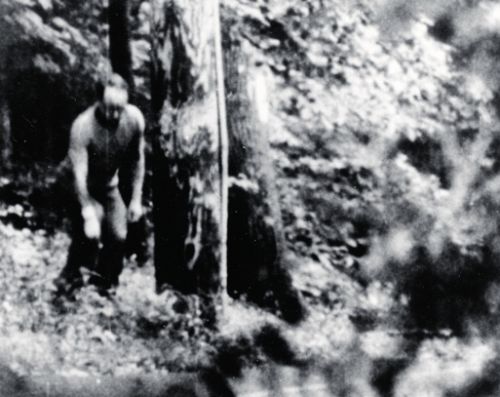
I like them because you really can’t tell what happened. They’re completely ambiguous. They’re supposed to say something and they really don’t.
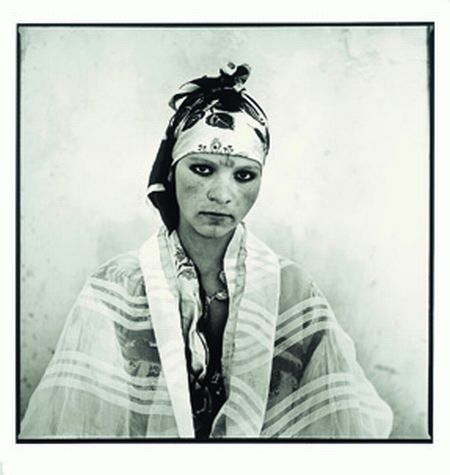
Marc Garanger, Femme Algerienne, 1960 collection SFMOMA, Accessions committee Fund purchase; © Marc Garanger

And these [images by Marc Garanger, 1960] are interesting. The photographer is a French soldier, who, during the Algerian War was sent to photograph woman to keep police records of them. Everyone had to have an identification card. And these are women whose faces had not been seen by anyone except their families. He had to insist that they take their veil off and be photographed. So two things that these women don’t appreciate, that kind of invasiveness and the graven image thing. The experience of doing this radicalized the photographer. He now uses these as documents of how we shouldn’t treat people.

Looking through these surveillance images, a lot of what this show is about is technology.
But also the meaning of technology and what technology looks like. You have to see it to be able to understand it. In the next room are more personal investigations of surveillance. This is a very interesting piece by Yoko Ono where she follows this person. It’s called Rape, but she’s just following someone.

Again with the creepiness.
It is creepy, but it’s also fascinating once you get into it.

Shizuka Yokomizo, Stranger No. 2, 1999 San Francisco Museum of Modern Art, Accessions Committee Fund purchase; © Shizuka Yokomizo

These are other images [work by Shizuka Yokomizo] that you feel like you really shouldn’t be looking at because they’re so invasive.
Well, she’s this little Japanese lady and she writes to these people and says, “I’d like to take your picture through your window at night. And if you don’t want me to, just close the curtain.” She never actually talks to them directly. She just leaves this note in the mailbox. Of course, they can’t see her —

But they seem to be looking right at her. So, we’ve reached the end of the show here. Is there anything in particular that you would like the viewer take away from this show or think about.
I think the thing to think about is how powerful this is in our culture. How much a part of our culture it is. It’s infiltrated our lives. And, we might want to think about that. Not to be judgmental, but to understand what it means to us as a culture.
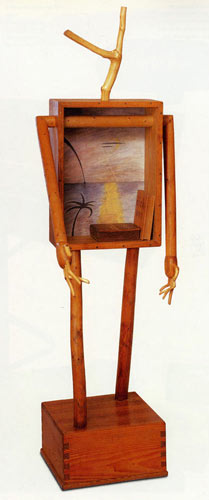
"Female Figure" by H.C. Westermann

This funky, fun show (on view through December 18, 2010) highlights work by two highly accomplished and similarly offbeat artists, William T. Wiley and H.C. Westermann. Wiley is one of the founders of the West Coast Funk movement and a masterful watercolorist, and Westermann is known for his inventive child-art or “low brow” aesthetic ,with doses of Surrealism. Make no mistake, this is finely crafted work, a fact particularly discernable in his sculpture. Of particular note is the use of unusual materials.

The two are linked art-historically for their 1960s and ’70s fine-art counterculture ways. Specifically, the artists turned away from mainstream art trends, be it minimalism or Abstract Expressionism. The two are also linked on more personal terms. Wiley (the younger of the two) was influenced by Westermann’s work; a mutual admiration developed over the artists’ years-long friendship and correspondence.

Common to both artists’ works are handwritten words and phrases, including a generous spattering of puns and sarcasm. The text reinforces the message, as well as the humor. There are also nods to art history. The works are highly personal and often emotional, making them truly individualistic.

Examples on view here show both artists at their best. From Westermann we see work spanning 1969 to 1980 (the artist passed in 1981), and from Wiley, mostly recent works, from 2009 and 2010. The quirky cartoonish, outsider-art appearance of these pieces belies their thinly veiled sophistication. It doesn’t take much more than a short pause to uncover the layers and rich storylines embedded in the pieces.

The subjects addressed are often weighty, including war, a major focus of Westermann’s, resulting from his personal experience serving in World War II. Death Black Ship (1972) — the ship is a recurring icon in Westermann’s work — is a wonderful example of such conflict-focused work. A battle rages off to one side, colorful and full of movement, while in the foreground, two rats sit on a ship’s deck with the quote, “Spectre though I may be, I am not sent to scare thee or deceive, But in reward of thy fidelity,” along with the attribution to Wordsworth, just off to their left. The sculpture Death Ship of No Port with a List (1969) demonstrates Westermann’s fine skill as a woodworker, while The Deerslayer (1969) shows off his use of odd materials — it’s a figure made of metal pipe with a head of deer horns — and ironic humor.

Wiley’s pieces examine variously our deteriorating environment, Eastern philosophy, wisdom (or lack thereof), social inequities, and an array of social-political subjects. The dunce cap features prominently in several of the works. It serves as a symbol of expression regarding the idiocies around us. For instance, in Dunce One (2009) — from a series of four works, each of which features one yellow cap decorated with words (and a lot of word play), phrases, and random imagery — features the phrase, “seems like it would be better to pay people to be good/cheaper than not helping them.” Not to be overshadowed by the abundance of text in most of these works is, indeed, Wiley’s talent as a painter; of particular note here are the pieces True Safety (2009) and Is This Double Dip Expression (2010).

Though very much about their time, this pair of artists, their work imbued with humanity, will and do endure

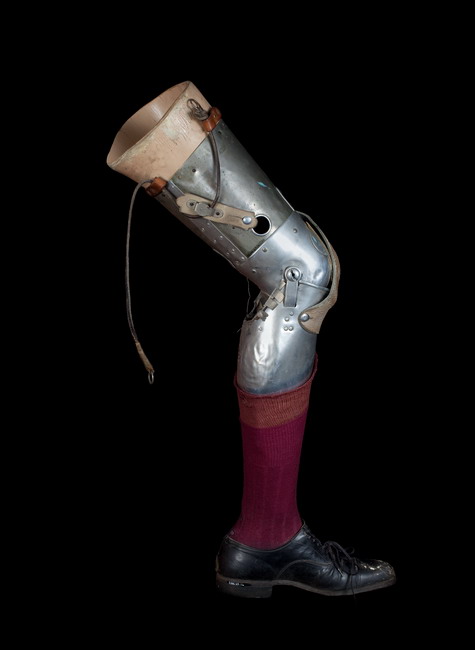
"Left Leg" by Catherine Wagner

Catherine Wagner’s photographs of splints (on show at Stephen Wirtz Gallery through December 18, 2010) — the medical devices used to stabilize injuries and often associated with war wounds — and antique prostheses are riveting. Each of these technically precise images shows one device against a flat black background in gentle, even light; the device appears to float in the space. Isolated, showing fine detail, these images are intense. Splints and prosthetics are highly personal. They’re held tight or molded to the body and worn for protection and recovery, repair. Thus, the title of the exhibition “Reparations,” implying making amends. It’s a loaded concept especially in this time of multiple international conflicts, and also an indirect path from which to approach such difficult subjects. Wagner points us in a hopeful direction.

Wagner deliberately chooses to photograph splints and prostheses made at various points through history, thus there is a didactic angle that displays the progression that’s been made in this field of medicine. For all of their references and dramatic portrayal, these are highly evocative pieces. For some, they illicit fear, repulsion, or sadness. But they also symbolize healing and help: everything will be set right, allowing for a return to normal life. Behind each object, we know there is a story, perhaps glorious, perhaps tragic, perhaps comic. The absence of the person who wore the device begs the question of his or her fate. And then they are, in many cases, intriguing simply as sculptural pieces. These direct, thought-provoking images convey the power of a well-chosen and expertly photographed subject.

"Glimmer" by Will Rogan

Will Rogan presents quietly intricate photographs and sculpture that continue his pursuit of finding the extraordinary in his everyday urban surroundings in his solo exhibition at Altman Siegel Gallery (through November 6, 2010). This provides him a path by which he explores themes of time, impermanence, relationships, and fragility. Similar visual elements also repeat: eyes, light reflected off shiny surfaces, portraits.

Each theme or visual element will pop up in several pieces, but none is present in all of the works. For the viewer, it presents a fun game of “find the similarities” among the different works; they are evident in big ways and small details. In several instances, themes loop over themselves, adding layers and complexity.

Viewing the Past as it Happens, Men Versus Clock: the Unequal Struggle, and The Elusive Nature of Time are each a photograph of a spread from a book about time; the titles of the works are the topic that is covered in the spread. The book itself is clearly dated. It has become a victim of the topic it addresses. The photographs themselves document a moment, which immediately becomes the past. They can never capture the present because as soon as they do, it is gone. Nothing is permanent.

Impermanence is also present in Can and Glimmer. Each image features an instant of the sun hitting a reflective surface – an aluminum can in the former; a piece of broken mirror in the latter – providing a flash of brightness in an otherwise dull and ugly landscape. These are two more examples of Rogan highlighting something “fantastic,” however brief, where otherwise we would see only decay.

Rogan has that wonderful ability to create work that is both complicated – there’s so much going on it can make your brain hurt, or alternatively jump for joy – as well as peacefully evocative. At times images are downright elegant and beautiful. When drawing our attention to a googly eye reflected in a mirror in The Floor, he also permits that serious are can be quite playful.

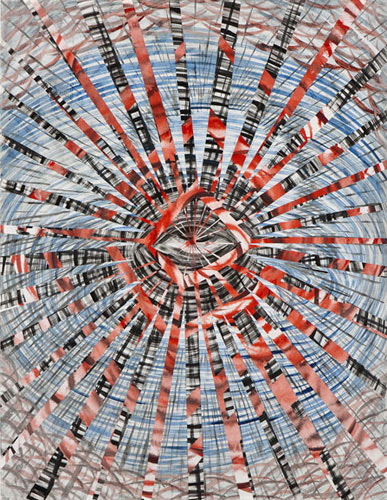
"Eye (Red, White, Blue) by Andrew Schoultz

San Francisco artist Andrew Schoultz’s newest work (on show through October 23, 2010) comes at you like an explosion. It’s big, bold, and colorful. It’s also serious, playful, and chaotic. The show features collage and acrylic paintings, monotypes, and large-scale sculpture. Throughout, Schoultz utilizes graphic/illustrative imagery regularly featured in past work as well as his exquisitely detailed line work. In every piece there is more than a lot going on. They work on numerous levels, foremost hovering between representation and abstraction. They are a brightly twisted playground for the eye and the mind, a trip down the rabbit hole with serious social commentary.

Schoultz came out of the graffiti scene; he put up his first tag while he was still in grade school. This street experience is reflected in his gallery work, most obviously in his penchant for large scale. He counter-balances this with innumerable small elements. The play of scale gives the work a great deal of depth and movement.

He also reworks the same images over and over, in the same manner that tags are repeated again and again on the street. For Shoultz, this repetition serves two purposes. It’s a form of storytelling: “In stories,” Schoultz said in a 2006 interview with Fecal Face, “characters reoccur and build themselves. I like the idea of developing a character or an image.” He also notes that by painting the same subject year after year, it slowly changes and finds fresh meaning. Throughout this body of work, we see the medieval horse, the eye of Providence (a graphic eye as appears on the one-dollar bill), tornados, bricks, and buildings askew. They serve as powerful symbols of Schoultz’s explorations: issues of man versus nature, history (and its sad repetition), environmental concerns, and globalization.

Like that of any good storyteller, Schoultz’s narrative does evolve, often to address current events. Reclamation, Oil, Water, for instance, is a commentary on the Gulf oil spill. The tornado (loss of control to nature) and eye are present. Schoultz also throws in a few other not so subtle but well placed ideas: the rippling water creates a camouflage pattern (war for oil), and the shimmering silver paint on a structure being transported on the water looks a lot like an oil slick (the true cost of global commerce).

The final crossover from Schoultz’s street work is the audience he addresses: the public. It shows a capacity to appeal to a broad audience, from children to the well-versed art lover.

Not to be overlooked is Schoultz’s use of color, which plays out in several ways. Red, white, and blue figure prominently in several works (a flag reference). And the messages are clear. In the large wall sculpture Broken Wall (in Three Parts) the American colors are separated to suggest a country divided or breaking apart. And gold, on bricks no less, figures prominently, especially in the enormous (and self-explanatory) Brick Wall (Gold).

Color also contributes to the many ways any given piece can be experienced. Explosion, a work made of layer upon layer of collage and innumerable graphics and images, as well as pieces of dollar bills, features numerous accents of different neon colors. From far away, these punchy tones read like a fairly un-modulated color-field painting. Up close, the eye reads color frantically in this wonderfully active work.

In this exhibition we are also privy to two types of work either not before seen, or not common to Schoultz’s oeuvre. New are his acrylic-on-found-antique-metal-plate-print paintings. In these black-and-white pieces, mostly comprised of his “Revisiting Insignificant Moments in History” series, Schoultz paints his own intricately lined iconography over the intricately lined images of the original prints, deftly merging past and present. Schoultz also presents a number of prints, most notably the monotype series “Compound Eye.” Each print features a one solid color, the eye graphic subtly present in a slightly different hue. The eye looks like a fingerprint or the rings of a tree. The series together is a breakdown of all the primary colors present in the show.

Design a site like this with WordPress.com
Get started