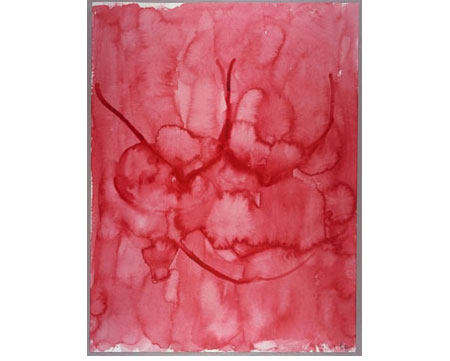
Louise Bourgeois's "The Feeding"

The vast ouvre of internationally recognized and legendary artist Louise Bourgeois, now 98, has always been personal, often autobiographical. The artist has also worked in a wide variety of media. This show of newer work at Gallery Paule Anglim, titled “Mother and Child” (on view through June 12), features both aspects. On view are sculptures, verse, gouache drawings, and prints focused on motherhood, sexuality, birthing, the female power to create, aging, and dying. With these, then, Bourgeois also continues her career-long attention to the experience of being a housewife/mother, further establishing her as one of our most important feminist artists.

Bourgeouis’s work can tilt towards heavy-handedness, particularly when it engages in overly literal, sometimes gruesome, dipictions of pain and fear. That is not a problem here; in fact, quite the opposite.

The gems of the show are the thirteen gouache drawings. This is particularly interesting given the imagery – graphic birthing scenes and nudes of pregnant women that depict the fetus in utero – and the fact that they are all painted in blood red on a flat white background. Crudely painted to the point of being almost abstract, with edges blurred by the watery gouache, they are approachable and, somehow, sad. They reveal themselves slowly; from the forms emerge a baby’s head from between two legs, and oversized breasts. These are solitary women, swollen and alone. Slightly more abstract, and quiet, are the two medium-size bronze sculptures. From Bourgeois’s “Echo” series, these are casts of sweaters that had been soaked and stuffed; they’re both painted white. Hinting at the human figure, the sagging, drooping forms poetically speak to emptiness, aging, and death.

Intimate, shocking, scary, viseral, beautiful, Bourgeois here succeeds as only someone with years of experience at her craft and art, and a long life of intense and moving experiences fully felt, is able. She gets to you where it counts.

Davide Coltro's "Living Shrouds," detail

One hundred black-and-white portraits, with an emphasis toward the black end of the scale, repetitively line the walls of this solo exhibition by new media Milan-based artist Davide Coltro (on view April 1 through May15, 2010). Each work measures 16-by-13 inches and is encased in a plastic sleeve; the sole break in the lineup: a screen, similar in size to the portraits, playing a random feed of hundreds of these images, here brightly colored, melding slowly into each other, one after the next.

The portraits, which feature Coltro’s friends or people he’s met, were created with a standard office photocopier; the subject laid his or her head on the machine. This accounts for the mostly three-quarter or full profiles, with only a few head-on shots. The method also explains the darkness of the images and that everything surrounding the face is black.

To create the continually morphing screen feed, the artist uses a proprietary algorithm he wrote, which resizes, colors, and combines the portraits. The screen recalls and further pushes the work, “[Systems],” featured in the artist’s first exhibition at Wolfe Contemporary (2007), which focused on landscape. Again, Coltro approaches a traditional genre through his lens of unique technology.
While the printouts serve to support the screen module, the combination works well as a whole. While the screen steadily presents a never-ending march of faces over time, the single portraits snaking the gallery walls offer the whole crowd, all at once. And both views upend the genre: whereas portraiture originally highlighted an individual’s uniqueness, set him or her apart, these streams of faces remind us that we are one of many. The xeroxing process, which renders a visual sameness, reinforces this . So stark, unflattering, and similarly produced are the images, beauty and status become a non-factor. The end result is one of equitability and unification.

The one off-putting aspect of the show is the plastic encasing of the images; wavy and reflective, it makes the portraits difficult to see. (It’s curious to learn that this display was insisted on by the artist.) But still, the show works. The flow of images is harmonious; the screen, especially, is mesmerizing. And, this is at its heart a conceptual piece; it is the idea we take with us. We are all a part of this, in it together. There’s a comfort in that.

This review originally ran in art, ltd magazine.

Design a site like this with WordPress.com
Get started