"Bricks (Budapest)," by Tamas Dezso, 2009

Isolation, bleakness, and decay have a strong presence in this solo exhibition (up through November 23, 2011) of photographs by Hungarian artist and photo-journalist (he’s been published in Time, the New York Times, and National Geographic, among other publications) Tamas Dezso. But while the tone may be dour, the serene poetry of these works leaves one feeling more dreamy than depressed.

The works on exhibit (2009–2011) are all part of the series “Here, Anywhere” (recently awarded first place at the 2011 International Center Awards and the Daylight Magazine and Center for Documentary Studies Project Prize), which documents Hungary’s “vanishing past”—the edges of Hungarian culture that are being lost to post-communist-era changes.

These images, then, serve as poignant and powerful documentation of a culture experiencing profound transition as well as formally conscious works of art. As regards the latter point, these pieces capture moments of rhythmic chaos and juxtaposed textures—a flock of black birds flying above leafless trees against a grey sky; a man atop a huge pile of white bricks in front of a large brick wall; a field of dying sunflowers. These are moments of quiet, and are both arresting and contemplative.

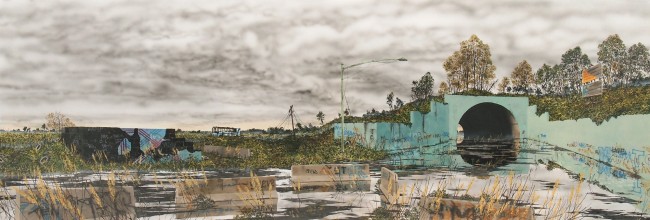
Alex Lukas, "Untitled," 2011

Apocalyptic American landscapes fill the walls in Philadelphia-based artist Alex Lukas’s current exhibition (on show through October 8, 2011). The twenty-five works here range in size from 6-by-10 inches to 25-by-72 inches. The undisputed centerpiece is an enormous cyclorama in the center of the gallery that measures 4.6 x 33 feet; the work is displayed in an arc that surrounds the viewer so that it encompasses one’s entire field of vision.

Two types of scenes are presented here. Metropolis-scapes appear underwater, overtaken by lush vegetation and what appear to be decaying swampy suburban areas. The revisiting of very similar imagery does become repetitive is too frequent, causing the initial emotion response to dissipate.

The cyclorama features the second, suburban-y scene. The format itself is significant not only because of its grand size but also because its original message juxtaposes powerfully against its message here. Cycloramas were a format used during the 19th century to display scenes that commemorated national strength, such as battles won; here it envisions the ultimate power as nature (to the demise of a superpower). It is tempting to extrapolate that the action in the original cycloramas (e.g., war, striving for ultimate power) may well lead to the condition presented in the current cyclorama.

In all of the works there is not a human in sight, but there are traces everywhere, in the form of buildings, deteriorating billboards, and graffiti. The latter is especially poignant, pointing to what is often the most enduring and powerful form of communication to distant generations and after general destruction: writing on walls. That graffiti might be the only surviving remnants of man amounts to the proverbial “writing on the wall”: we should have seen this coming.

What is particularly striking in these works, as opposed to other end-of-days art (think Sandow Birk’s series The Rise and Fall of Los Angeles or Albrecht Dürer’s The Four Horsemen of the Apocalypse), is that the images feel peaceful. Waters are still and clear. There is no fire; there are no explosions. Trees and bushes are healthy and abundant. Doom is paired with serenity.

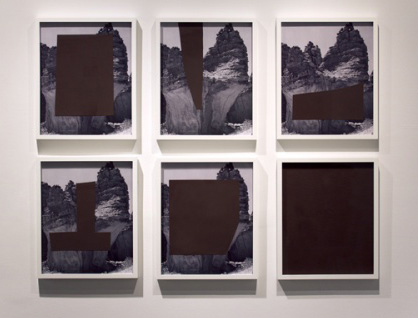
Brion Nuda Rosch, "Time as Concept (Infinity)," 2011

Brion Nuda Rosch presents twenty-three new works ranging from a large diptych painting to numerous smaller collages (through October 1, 2011). Many are reminiscent of the work Rosch has shown over the past few years, featuring a found image, often of a black-and-white landscape, with a painted, cut-out, four-cornered form placed on it. The form in these works is painted flat brown, perhaps a stand-in for the earth, or some sort of firm grounding. These and other works play with formal concerns such as foreground and background, form, and composition.

Perhaps the most poignant piece of this ilk is the sextet of same-sized works, arranged grid-like in three columns of two, Time as Concept (Infinity). The background image is the same in every piece; the brown shape is the only variable, changing in size and form. In the lower-right-hand work (the “last” piece) the brown shape fills the frame. What, then, is the image? Is this, or where is, the content? By showing us “something” and then “nothing,” Rosch effectively demonstrates what is at the heart of his work; he questions the foundations of image-making.

At times Rosch’s minimalist approach becomes too minimal, as with the piece Two Right Angles in Conversation, a framed cut-out piece of cardboard with rough strokes of brown paint on it. We consider the form, and move on. But when he’s on point, which he is numerous times in this show, Rosch provides us with sharply edited works that simply, elegantly address major concepts with a minimum of fuss.

Follow

Get every new post delivered to your Inbox.

Join 116 other followers