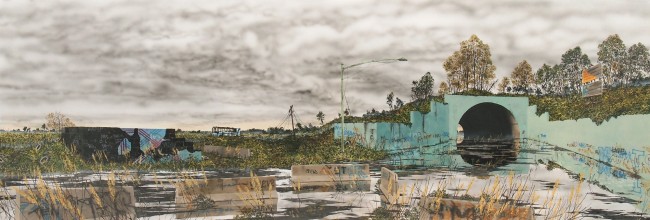
Alex Lukas, "Untitled," 2011

Apocalyptic American landscapes fill the walls in Philadelphia-based artist Alex Lukas’s current exhibition (on show through October 8, 2011). The twenty-five works here range in size from 6-by-10 inches to 25-by-72 inches. The undisputed centerpiece is an enormous cyclorama in the center of the gallery that measures 4.6 x 33 feet; the work is displayed in an arc that surrounds the viewer so that it encompasses one’s entire field of vision.

Two types of scenes are presented here. Metropolis-scapes appear underwater, overtaken by lush vegetation and what appear to be decaying swampy suburban areas. The revisiting of very similar imagery does become repetitive is too frequent, causing the initial emotion response to dissipate.

The cyclorama features the second, suburban-y scene. The format itself is significant not only because of its grand size but also because its original message juxtaposes powerfully against its message here. Cycloramas were a format used during the 19th century to display scenes that commemorated national strength, such as battles won; here it envisions the ultimate power as nature (to the demise of a superpower). It is tempting to extrapolate that the action in the original cycloramas (e.g., war, striving for ultimate power) may well lead to the condition presented in the current cyclorama.

In all of the works there is not a human in sight, but there are traces everywhere, in the form of buildings, deteriorating billboards, and graffiti. The latter is especially poignant, pointing to what is often the most enduring and powerful form of communication to distant generations and after general destruction: writing on walls. That graffiti might be the only surviving remnants of man amounts to the proverbial “writing on the wall”: we should have seen this coming.

What is particularly striking in these works, as opposed to other end-of-days art (think Sandow Birk’s series The Rise and Fall of Los Angeles or Albrecht Dürer’s The Four Horsemen of the Apocalypse), is that the images feel peaceful. Waters are still and clear. There is no fire; there are no explosions. Trees and bushes are healthy and abundant. Doom is paired with serenity.

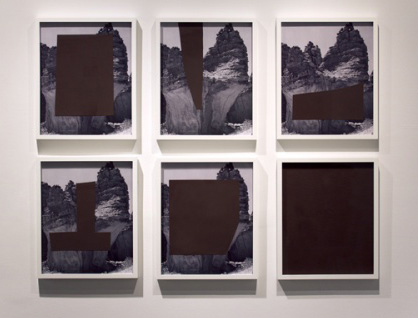
Brion Nuda Rosch, "Time as Concept (Infinity)," 2011

Brion Nuda Rosch presents twenty-three new works ranging from a large diptych painting to numerous smaller collages (through October 1, 2011). Many are reminiscent of the work Rosch has shown over the past few years, featuring a found image, often of a black-and-white landscape, with a painted, cut-out, four-cornered form placed on it. The form in these works is painted flat brown, perhaps a stand-in for the earth, or some sort of firm grounding. These and other works play with formal concerns such as foreground and background, form, and composition.

Perhaps the most poignant piece of this ilk is the sextet of same-sized works, arranged grid-like in three columns of two, Time as Concept (Infinity). The background image is the same in every piece; the brown shape is the only variable, changing in size and form. In the lower-right-hand work (the “last” piece) the brown shape fills the frame. What, then, is the image? Is this, or where is, the content? By showing us “something” and then “nothing,” Rosch effectively demonstrates what is at the heart of his work; he questions the foundations of image-making.

At times Rosch’s minimalist approach becomes too minimal, as with the piece Two Right Angles in Conversation, a framed cut-out piece of cardboard with rough strokes of brown paint on it. We consider the form, and move on. But when he’s on point, which he is numerous times in this show, Rosch provides us with sharply edited works that simply, elegantly address major concepts with a minimum of fuss.

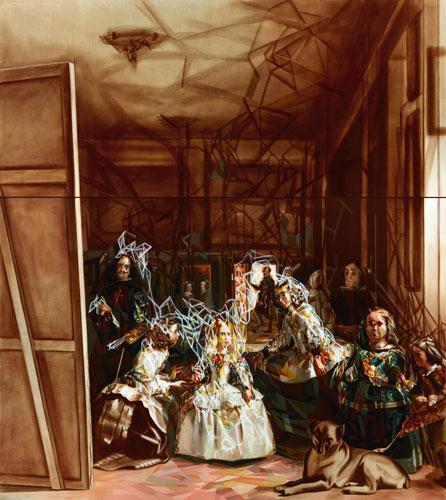
Joseph Park, "Wizard," 81 x 72 inches, oil on linen mounted on board, courtesy Rena Bransten Gallery

Joseph Park, whose recent work is featured in this solo exhibition (through August 20, 2011), “This is Prizmism,” is an outstanding painter. It is apparent as soon as you enter the gallery, which is divided into three specific sections: one representing the “school” of prizmism (works done in a variety of explorations using the style); another, the full realization of the style; the third, the “masterpiece”—we are witness to the steady progression of a genre.

This is a style that the artist has developed and, as the name implies, subjects look as if they’re being seen, at least partially, through a prism: angular and often featuring a riot of dazzling color.

Fittingly, the school section features figure studies, plaster casts of heads, and the equipment the artist uses to practice his craft, namely, an easel that can hold the artwork at any angle or orientation and at a variety of heights. In the next room are eight medium-sized works of various subjects: a portrait of Van Gogh, a self-portrait, two home interiors, a pair of abstract works—demonstrating a full range or realization of the application of prizmism. The final room has only one work: “Wizard,” a large (81 x 72 inches) prizmism-ed take on Diego Velásquez’ “Las Meninas;” a nice art historical nod not unlike those we find in the work of Vik Muniz.

The show’s concept hovers on gimmickry. As other critics have noted, the work tends to be overly rich and somewhat show off–ish. But this can be forgiven: Showing off is only unforgivable if you can’t deliver. And Park delivers. He inspires us to want to look with care at each and every painting; to realize which works alone make his case. If he adds on beyond that, the rest serves to demonstrate that Park is a master of his vision.

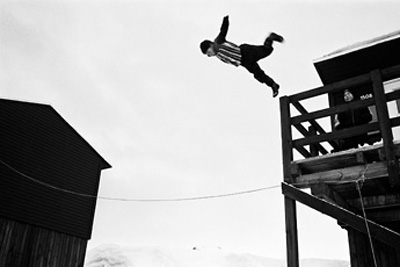
Jacob Aue Sobol, "Untitled #8," from the series "Sabine," 1999-2002; gelatin silver print. Courtesy the artist and Yossi Milo Gallery, New York; © Jacob Aue Sobol, courtesy Yossi Milo Gallery, New York.

Five spacious rooms, each featuring a series of works by a different artist—Jim Goldberg, Daniel Schwartz, Zanele Muholi, Jacob Aue Sobol, Richard Misrach—comprise this wide-ranging, direct, and personal photography exhibition. Like the book project from which the exhibition takes its name, published in 1929 by German photographer August Sander, this show aims to capture our contemporary moment in time by looking at the “faces” (mostly the photographs feature people, save Mirach’s series, which features graffiti in post-Katrina New Orleans) of specific situations around the world.

The show opens with poignant as well as beautiful images from San Francisco–based Goldberg’s series “Open See.” The series comes out of a project documenting new European immigrants and focuses on the African countries they come from. The people photographed, all of whom are desperately poor, are often facing the camera and shown within the context of their surroundings, be that a small hut or standing atop a pile of rubble. Throughout, they exhibit an undeniable strength—which, we assume, can only be known by those who have survived deplorable situations.

In the next room are thoughtful, meditative works from Schwartz’ series “Traveling Through the Eye of History.” From 1995 to 2007, the artist captured images along the historic Silk Route, which travels through parts of central Asia, Afghanistan, Iran, Kashmir, western China, and Mongolia. Especially as regards areas that have been heavily affected by war (particularly Afghanistan), these are refreshing for their everyday look. And while we see signs that conflict has taken place—most notably the large empty space in an Afghan hillside where a giant Buddha (destroyed by the Taliban) once resided—the images aren’t about the drama of particular moments in history. This is what you see, what you experience, just being in this place; these are people going about their daily business.

South African photographer Zanele Muholi presents straight-ahead, formal, background-less, black-and-white portraits of transgendered and homosexual South Africans, people who are often targets of violence, discrimination and ridicule. We are informed that even the most violent acts against these people go unpunished because there are no laws regarding hate crimes in South Africa; some of those photographed have died as a result of this violence. The works are undeniably powerful; the strong, direct, “everyday” people—none of them stand out visually in any obvious ways—who serve at Muholi’s subjects put a face on a horrible circumstance.

Aue Sobol presents candid shots from the life of his girlfriend in her hometown of Tiniteqilaaq, a small fishing village in east Greenland. The work is intimate and has an atmospheric quality. The haziness, off-kilter angles, and personal moments captured balance the rest of the exhibition, which elsewhere is more formally polished.

The exhibition ends on a sad but somewhat humorous note, with Misrach’s post-Katrina images of graffiti messages on New Orleans homes that were devastated by the floods. These works feature not one person (or any other living being, for that matter), but are nevertheless alive with raw human emotion: sarcasm, disappointment, sorrow, and anger. This is what happens when you have nothing more to lose. From the undeniably funny “wicked witch” painted on the side of a house, with an arrow pointing down to the ground, to the defensive and confrontational “I am here; I have a gun” painted on boarded up windows, Misrach deftly, elegantly conveys the wide range of reactions elicited by those who suffered the worst of the storm.

These artists put a human face, one we can identify with, on situations a great many of us have no personal experience with. They bring far-away situations into our direct contact, without drama or fanfare. These instances are as remarkable as they are ordinary. The power of the exhibition, then, lies in the ability of these works to touch on intense, loaded, or very personal subjects and remain fascinating to fully digest. These works don’t punch or shock; they gently, beautifully present our reality, and are an opportunity to take it all in.

This exhibition continues through October 16, 2011.
Margaret Kilgallen, "Untitled," arylic on paper, c. 2000, 13.25 x 12 inches, courtesy Ratio 3, San Francisco

“Summer / Selections” (through August 5, 2011) is an excellent opportunity to view a healthy sampling of over 40 pieces, some of which have never been shown, by the late Margaret Kilgallen (she was only 33 when she died, in 2001). Kilgallen was a seminal member of what has been dubbed the Mission School, the graphic, folk-art-esque, street-art-inspired SF movement of the early 1990s that produced other such notables as Chris Johanson and Barry McGee (Kilgallen’s widower; the shared visual language between McGee and Kilgallen is evident in both artists’ work).

Kilgallen’s art is deeply rooted in craft, in particular that of sign-painting. Further lending a hand-hewn feel is her use of roughly sewn-together canvases and repurposing of paper. But what is most captivating about Kilgallen’s work is her use of line, shape, and color, and the attention cast on everyday subjects and objects: trees, leaves, faces, shoes, and even simple repeated patterns. With minimal crisp, smooth edges used to delineate her graphic, highly stylized depictions filled in with only one or maybe two flat colors, Kilgallen operates with maximum efficiency to maximum effect. The commonplace is elevated to a level of rich meaning; Kilgallen speaks in elegant visual haikus.

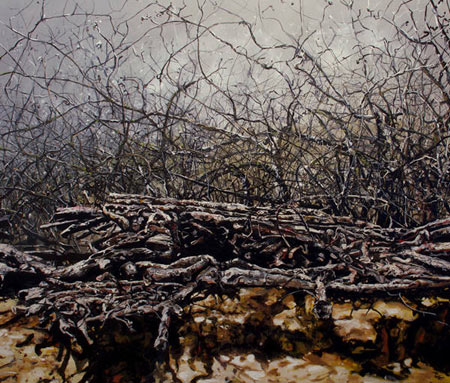
"Gentle Surrender" by Eric Zener

In his new body of work—on show at Hespe Gallery through May 31—Marin-based painter Eric Zener addresses an entirely new subject: trees and bushes. The show includes mostly oil-on-canvas work, with only a few mixed-media pieces, the latter of which have dominated recent exhibitions. Known for his dreamy, intensely colorful, layered resin-and-paint images of underwater swimmers and water-focused work, which he’s been creating since 1998, this new direction is a total departure.

As with the earlier work, these pieces are photo-based. But while the hyper-real glossy mixed-media works (which actually begin with a photo transfer) demonstrate the depth and vibrancy Zener has excelled with in the past, it’s the paintings that steal the show. From afar they do maintain a photorealistic quality (indeed, digital images of the paintings may lead you to believe that they are actually photographs), but closer up, gestural brushstrokes reveal the medium; these are painterly works.

The subjects depicted are predominantly of trees with dense and messy branches, sometimes bare and in one case, on fire; up very close, the tangle of foliage verges on abstraction. These subjects could, in many cases, be dead, or just barely surviving a cold winter. The palette is equally as sparse; several works are done in black and white. When leaves and hue are present, the coloring is subtle enough to allow the frenetic composition to hold court. These works are a study in the beauty and intuitive order that can be found in nature’s chaos; they are immediately reminiscent of Lee Friendlander’s images of similar subjects, as from his “New Mexico” series, and have a similar affect on the viewer: they’re calming and mesmerizing.

Zener moves with this series from explorations of life to death—and, in the case of the fire painting, destruction. He moves from wet to dry, sooth to rough, bright to somber, glossy to matte, simple to complex. He’s removed the fluid figure and replaced it with a nature that’s impenetrable. These works are more difficult, and less inviting, and with them Zener hits a whole new stride.

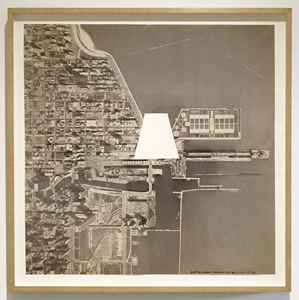
Sol LeWitt, "A Square of Chicago Without a Trapezoid" (1979), altered photograph

Grids, formal studies, geometric shapes, and patterns fill the walls of San Francisco’s Fraenkel Gallery in this unique show of photography by seminal minimalist and conceptual artist Sol Lewitt (1928-2007), who is much better known for his sculpture and drawing. This is the first gallery exhibition to focus only on Lewitt’s photographs; the show, titled “Photographic Works, 1968-2004” and on up through April 30, 2011, spans the greater part of the artist’s career.

Some of the images directly transfer from Lewitt’s better known work. For instance, Buried Cube Containing an Object of Importance But Little Value (1968; it’s the oldest work in the show) is documentation of a conceptual work; the process of the action is presented in a sequential grid. The evidence of the artwork is now the artwork itself.

Wall signage also informs us that Lewitt was influenced by motion sequence photographer Eadweard Muybridge (incidentally, there is a large Muybridge retrospective currently up at nearby SFMOMA). We can readily see Lewitt’s interest in sequencing via A sphere lit from the top, all sides, and all their combinations (2004), a study comprising 28 images, arranged in a grid, of a sphere lit from various specific angles. Note too, the work is created by following instructions left by the artist, the same concept Lewitt applied to wall drawings.

Perhaps most informative of how the outside world influenced Lewitt’s work is Grids of Grids (1976), in which images of similar everyday objects – wooden doors, grates, skylights – are arranged grid-like, three up and eight across. Is this how the artist processed what he saw? Is this our opportunity to see things through his eyes? Or perhaps this is the artist studying and seeing repetition, which he then breaks down to its most elemental forms and lines in his paintings, drawings, and sculpture (or “structures” as he fittingly called his three-dimensional work). Here we get some insight into a formal process and vision, and get to look at some elegant, rigorous, contemplative imagery as well.

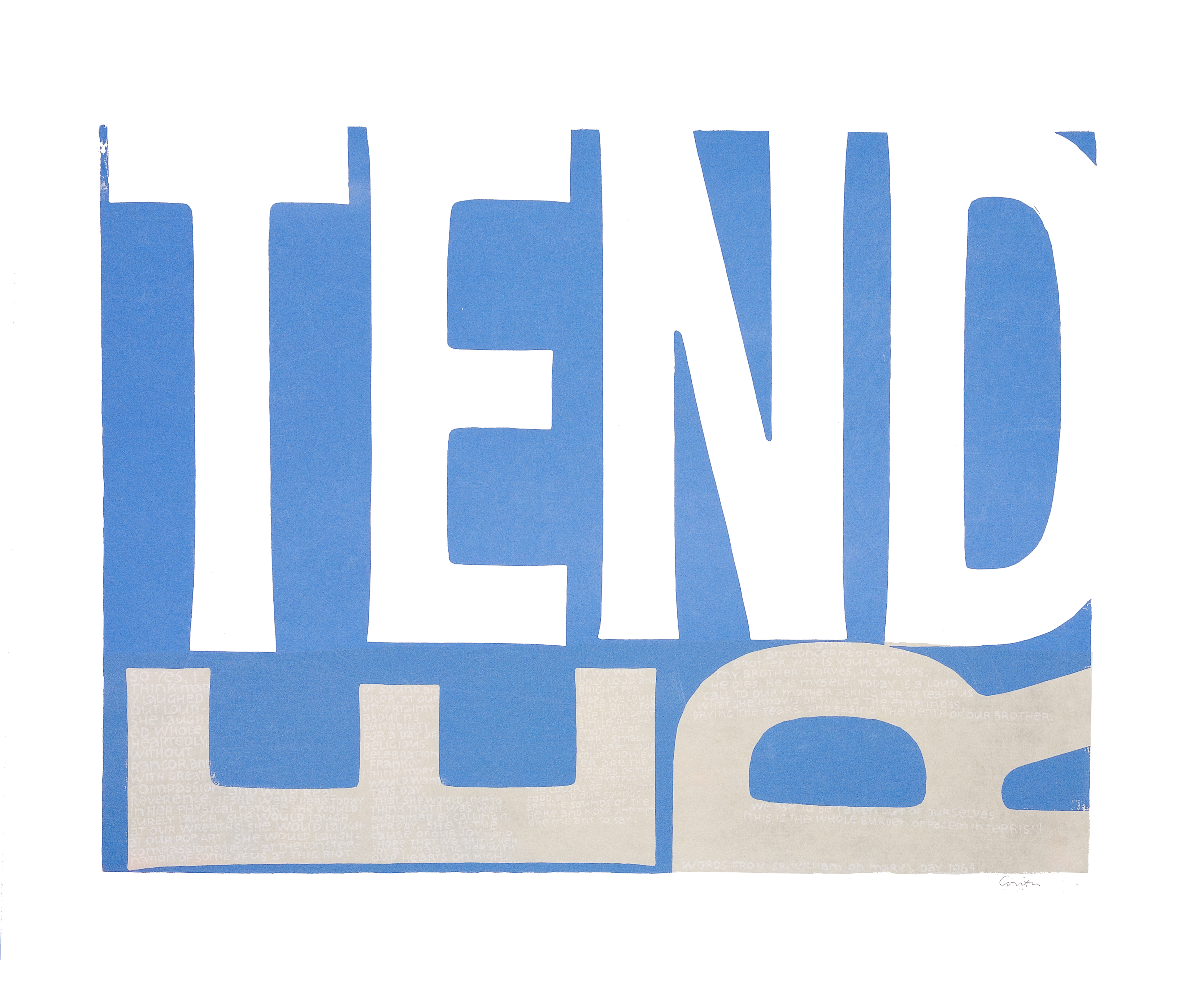
"Tender" by Sister Corita, 1974, Collection of Lucia Eames

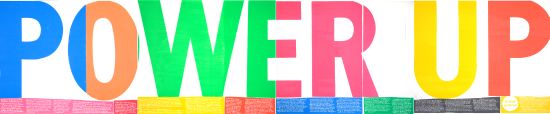
A blaze of bright color and bold graphics by Sister Corita (1918-1986; born Frances Elizabeth Kent, aka Sister Mary Corita and Sister Corita Kent) abound in this celebration of her life and impact at the San Francisco Museum of Craft and Folk Art (through June 5, 2011). Additionally fleshing out the importance of this influential West Coast Pop artist, innovative educator, and activist are ephemera, such as copies of the educational books Corita wrote; personal letters and photographs; and films and videos about the artist’s career and life. The exhibition “E is for Everyone: Celebrating Sister Corita” emphasizes key works from the 1960s, such as the iconic Power Up and Tender images as well as her close relationship with design couple Charles and Ray Eames.

Corita is known for crossing boundaries, be they creative or social. This comes through in this intimate (the museum encompasses one large gallery space) but still powerful exhibition. She was on the vanguard of pop and graphic art, working primarily in the discipline of screen-printing. The serigraphs she created combined graphic art, typography, music lyrics, social commentary, and literature to create her unique style. (Her teaching also reflected her cross-disciplinary interests; Corita co-taught classes at the Immaculate Heart College Art Department in Hollywood with such cultural icons as Alfred Hitchcock, John Cage, and Buckminster Fuller as well as the Eameses.) Her choice of medium fit well with her interest in social change and working class outlook on art and art-making, as her prints were easy to widely distribute and recreate. And they were: Corita was commissioned by Amnesty International and International Walk for Hunger, among other socially conscious organizations. Perhaps most widely known is her “Love” stamp, issued in 1985, and her notecards for the Campaign for Human Development (a collection of which are featured here).

"Power Up (A)" by Sister Corita, 1965, Collection of the Corita Art Center

Corita’s provocative spirit did not go unnoticed during her lifetime; in 1967 she was featured on the cover of Newsweek magazine; the cover line read: “The Nun: Going Modern.” And her influence continues: one can find correlations between the twenty-one works on show to contemporary artists such as Shepard Fairey, Ed Ruscha, and Pae White, and curators, graphic artists, and students continue to rediscover and draw from her work and teachings.

"Powerless" by Deborah Oropallo

The show of new work by Deborah Oropallo at Gallery 16 in San Francisco (through April 30) expands her exploration of gender power, the symbolism of the uniform and the role of iconic imagery in shaping female identity. One to continually push conventions of image-making and composition, Oropallo again exceeds herself.

In her work over the past several years, Oropallo had delved into juxtaposing famous portrait poses of 17th- and 18th-century portrait paintings of powerful men with modern-day lingerie modeling (its startling how similar the poses are). Following that, in 2009, it was collaged, strong, sexy rodeo cowgirl imagery, again juxtaposing a strong male archetype with a strong, sexy female-type.

A fitting next step, this new series takes on the rich topic of female fairy-tale figures and vulnerable/sex-kitteny female Pop imagery: Little Bo Peep, Rapunzel, Wonder Woman, French maid, Snow White, the Catholic school girl, and Alice in Wonderland all make an appearance here.

But though the references are pretty obvious, they are altered with the inclusion of bondage or S&M references, gas masks, ski masks, and other less cute imagery. These works have greater edge than previous pieces. Oropallo is growing increasingly bold, and the results are viciously engaging. They are funny, creepy, strange, whimsical, and powerful, without falling into easy traps of feminist bitterness or clichéd comparisons. Taken one way, they are comparisons of equal opposites—sweet and innocent versus aggressive and violent—bringing to question which really holds the power and the reality of either, or both, of the fantasies (and whose fantasies are they, anyway?); taken another, they are a collapsing together, all at once, of the potential numerous identities that comprise any single human being. These are well thought out pieces that pose intriguing open questions.

From a visual standpoint, the work is drop dead striking. Most are large, measuring 60-by-44 inches. And they have an incredible sense of depth — the imagery is layered and collaged—almost to the point of appearing three-dimensional. The structure of the images gives them movement and life; Oropallo is a master of composition. And in that, she’s become a great manipulator of the manipulators, using the language of visual messaging to bring those very messages into question.

Two intriguing collage exhibitions have recently been on view in the art-booming Mission district of San Francisco: Hilary Pecis, “Half Truths and Outright Lies,” at Guerrero Gallery (through March 5) and Sebastian Wahl, “Kaleidoscpe Eyes,” at Gallery Hijinks (through February 26). In both, you’ll find a barely controlled cacophony of imagery, captivating composition and fine craftsmanship, with a punctuation of playfulness.

Hilary Pecis, "Up to No Good," 2011; Giclee Print, edition 1 of 3; Courtesy Guerrero Gallery

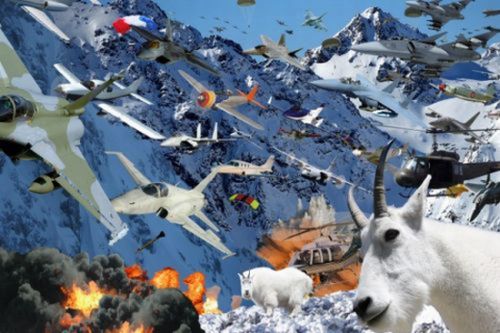
San Francsico-based Pecis tries a new medium with these new works: computer-based collage. Previously, Pecis hand-cut each piece of her finely detailed works which she then often enhanced with pen-and-ink patterned “doodles.” Using a computer has changed the work in two important ways: it is smoother, physically lacking the materiality of the handhewn pieces; and imagery has changed. Whereas Pecis had culled imagery from magazines — mostly fashion magazines, which accounted for their bright colors and loads of jewels and gems — now she’s got the entire Internet and we see everything from jets to kittens and mountain goats, pillows to trains and bombs exploding.

Hilary Pecis, "Kingdom," 2011; Giclee Print, edition 1 of 3; Courtesy Guerrero Gallery

Use of the Internet played a large part in image selection; Pecis often used images that randomly appeared during her searches to create her fantasy worlds. And this links to an interest that drives this body of work: the changing face of journalism, or information sharing (and subsequent worldview building), and resulting overload, both visual and written, which is increasingly empty of substantial content, is easily replaced, and is highly repetitive and self-referential. (As the press materials reveal, The title of the show is based on an Intelligence Squared debate, “Good Riddance to Mainstream Media,” which discusses the relevance and fate of traditional journalism and the blog. David Carr, a writer for the NY Times said “They become an echo chamber of half-truths, sometimes outright lies, without any real data points coming in. And so you end up with a sort of mass of people talking to each other, no one has read anything. No one knows anything. They’re talking about something that someone else read that read that read that read. And we end up in a meta-world.”)

One commonality that runs through almost all Pecis’s work is her penchant for tight, epic scapes. And here she continues to perform at top speed. Also in this show, and not to be overlooked, are two works that stray from the herd; they are calm, tranquil, the content highly edited down–perhaps created by layering image over image? The result of which is borderline nothingness. A preview of things to come?

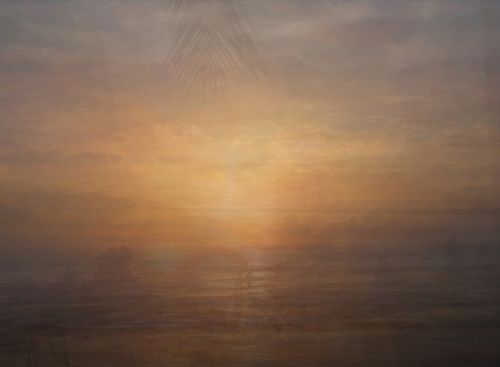
Hilary Pecis, "100 Perfect Sunsets," 2011; Giclee Print, edition 1 of 3; Courtesy Guerrero Gallery

Sebastian Wahl at Gallery Hijinks

Sebastian Wahl, "Kaleidoscope Eye 1," 2010; original collage in resin on panel"; Courtesy Gallery Hijinks

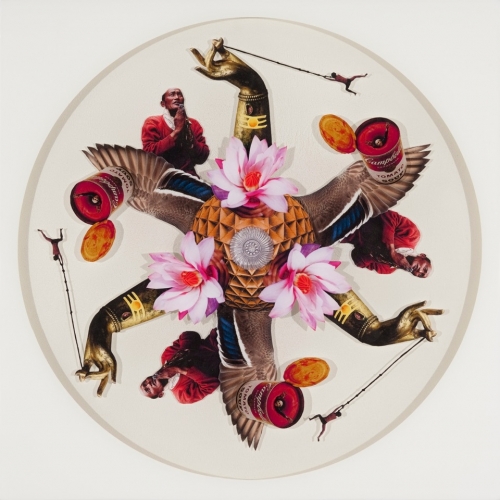
New York artist Sebastian Wahl makes his San Francisco debut in this solo exhibition. As the title of the exhibition points to, the works are arranged in patterns of multi-reflected imagery, as if one is looking through a kaleidoscope. Wahl’s hand-cut images range from cultural icons to architecture, the religious and spiritual to nature. Fine detail and careful, strangely witty placement abound: by example, Andy Warhol famously swims in a can of tomato soup positioned on a bird’s wing in Kaleidoscope Eye 1.

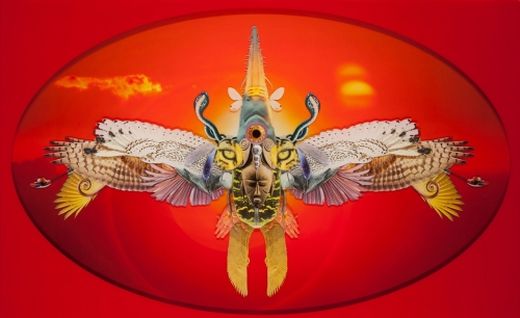
Sebastian Wahl, "Spirit Bird," 2010; original collage in resin on panel; Courtesy Gallery Hijinks

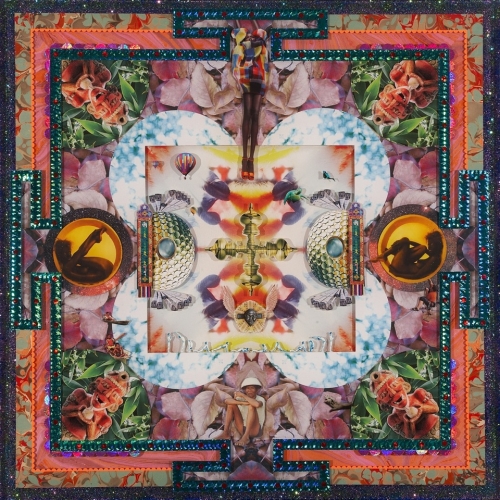
Also notable here is the craftsmanship: the works are made of up to fourteen thin layers of resin–a medium the artist has been working in since 2006 — each encasing its own images. This introduces an added and unexpected depth and dimension; the layers cast subtle shadows with shifting light. Wahl, a former graffiti artist, says he’s interested in creating works that promote mindfulness and concentration. And this gets to the greatest strength of these works: there is a calm in the chaos.

Sebastian Wahl, "Mandala 2," 2010; original collage in resin on panel; Courtesy Gallery Hijinks

Design a site like this with WordPress.com
Get started