"The Crooked Timber" by Chester Arnold

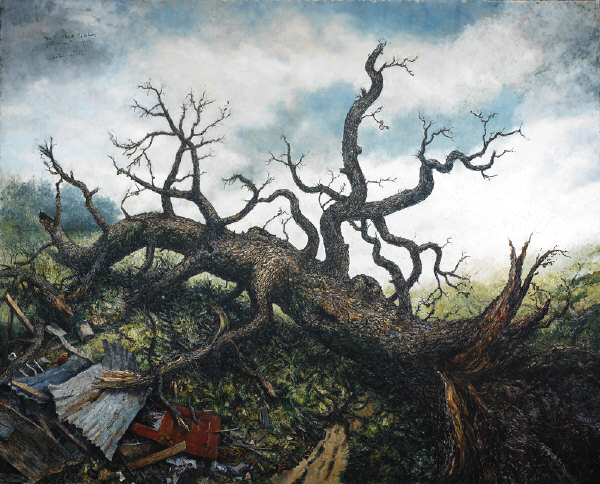
Chester Arnold’s paintings and drawings (here, studies of the larger oils on linen) are alive. Cliffs, fallen trees, piles of branches, and tree stumps pulse with personality, in this new body of works that are almost devoid of people. As he has in the past, Arnold based this series on a central theme, one of the artist’s favorite quotes, which was penned by the German philosopher Immanuel Kant: “From the crooked timber of humanity, nothing straight is ever made.”

In this exhibition, titled “The Crooked Timber and other paintings and drawings” and on view through July 3, Arnold continues to explore the intersection of man in nature in highly detailed and expertly stylized nature scenes. The wind’s chaos kicks up papers, deterioration, detritus, cut-down trees. In several works, the Sonoma-based artist also keeps the slightly elevated perspective found in previous paintings; the viewer surveys the scene from above. But these studies of decay, based as they are on such a doom-and-gloom declaration, do not depress. In these often large scale landscapes (several measure as large as 78 by 96 inches) are touches of humor; Arnold’s jaunty, fluid Van Gogh-like strokes result in an animated playfulness. There’s also an earthy, romantic appeal of times past–the allure of an abandoned old barn or rickety rope-and-wood-plank bridge. One comes away with a sense of optimism or hope: there’s a beauty and substance of character to be found among the gnarled wreckage.
This recommendation originally appeared on Visual Art Source.

"Away" by Erin Cone

Even with fast and wide praise of her paintings since her first (sell-out) solo show in 2003, Santa Fe–based artist Erin Cone continues to push her work, and it shows. Cone boldly, consciously explores new approaches to form, composition, and palette with each body of work she creates. The recent solo exhibition at Hespe Gallery in San Francisco shows the painter refining and developing. 

Cone paints stylized figures based on herself. (These aren’t self-portraits, however; Cone acts as model, not subject). She says, accurately, that her work is a fusion of figurative realism and abstract minimalism. The figure is almost always solitary against a flat background and usually cropped in an arresting way—off to one side cutting out an arm, three-quarters of the head cut off. These works are as much about forms and arrangement as they are about the figure itself. And they are strong; this is made obvious when noting that the impact of the work isn’t diminished when showing the figure from behind, typically a less engaging view.

Numerous influences and art historical connections can be seen in Cone’s work. The clean, stylized approach of the neoclassicists, albeit with a fresh approach; Cone’s figure, dressed in “office casual,” is a modern woman. Contemporarily, there is a resemblance, especially as regards cropping and also stylization, to the Pasadena-based artist Kenton Nelson. Cone herself states influences from Georgia O’Keefe, Caravaggio, Édouard Manet, Gerhard Richter, and Wayne Thiebaud, among others. Cone’s traditional influences—she’d originally wanted to be a portrait painter in the Old Master style—are contrasted by the bold, commercial feel of graphic design and the slickness of photography. Her surfaces are clean and smooth, unblemished. (Cone worked as a graphic designer at a publishing company before taking the leap to devote herself to painting full time.) Inspiration also comes from collage, fashion, and dance.

For this body of work, Cone has limited her palette. She’s playing with levels of contrast. Some work features less, such as Away, a quiet work with almost a sepia tone appearance. Work such as Allure, showing a partial upper portion of a figure with a bright red shirt again a blue-grey ground, shows more. But gone are, say, the hard orange backgrounds of past work. The new-found subtlety is welcome. Cone also softens her images and adds movement by showing afterimages, hints of where the body just was; it gives us more to see. And the rendering of the figure itself, verging slightly more toward realism, gives these paintings greater life and depth; they energize the work more than in the past, and they’re simply better painted. If there are criticisms to be made, it’s that Cone’s work can tend toward being too pretty and too rigid or graphic—flat, lacking depth. Cone’s to be credited, however, for seriously honing her craft and working through formal concerns. It’s an exciting process to watch and no small pursuit.

 Here we see a dedicated, talented painter steadily developing into an artist.

This review first appeared on VisualArtSource.com.

"From Above" by Patrick Wilson

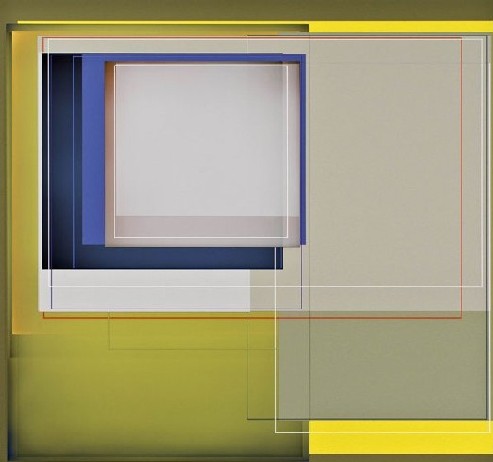
Since the point of this weekly selection is to pick one work of art to highlight, I forced myself to choose from the numerous outstanding paintings featured in Patrick Wilson’s solo exhibition, “The View From My Deck,” currently on view (but only until June 5, so get in to see it now!) at Marx & Zavattero. I’m always astonished by artists who can take something as simple as four-corner shapes and their outlines, and layers of color and, again and again, create exquisitely sublime art. I chose From Above for its subtle boldness, gentle resonance, and bravery (let’s face it: it’s an accomplishment to make sickly greenish yellow  and grey tones so appealing), but I’d happily rehang this entire show where I live; these are works that keep giving.

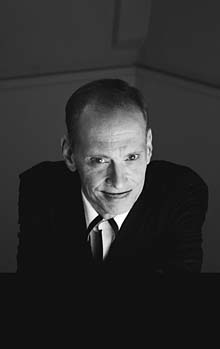
John WatersOn a recently sunny afternoon, I met up with the delightfully subversive John Waters at his cozy hilltop apartment, filled with beloved artwork and a loaded library. Best known for his positively perverse films—Hairspray, Pink Flamingos, Serial Mom, Pecker—Waters sat down to talk with me about everything but, including his take on his sometimes home, San Francisco.
In addition to discussing his favorite aspects of the city, Waters also filled me in on his fine art career and solo exhibition currently on show at SF’s Rena Bransten Gallery (through July 9), and his new book, Role Models, which features a series of essays about people, both famous and infamous, who have had a profound impact on Waters’s life.
Reflecting his mischievously humorous personality, the ever fashionable Waters was dressed in his signature style: anything by Comme des Garçon (the label’s founder and designer, Rei KawaKubo, is one of the role models featured in Waters’s book). He dove right into the interview gregariously introducing the conversation into the recorder, setting his fabulously filthy (as only the genre’s “king” can) tone from the start.

John Waters: We’re on with the Nob Hill Gazette. You know I’ve always wanted to do a porno movie with Nob Hill in the title but spelled K-N-O-B (burst of laughter). It’d play right down there at the Nob Hill Cinema. 
I lived here when I was young. It’s the first place my movies ever caught on outside of Baltimore and Provincetown. I lived in several places in the city including a commune on 18th and Church. The best thing about living here now is I lived, in 1970, in my car not far from here; it’s about the same now, but a little different. I just pay more now for clothes that look like they came from a thrift shop.

Chérie Turner: With a start like that, I think I might just throw out my questions! I do want to talk to you about San Francisco, but I also know you have some new projects that aren’t movies, which is what most people associate you with.

I have an art career, and I wrote this book, which took two-and-a-half years. I have this live show I do called Filthy World, which I tour all over. I just did Australia and sold out the Sydney Opera House, I’m proud to say. So I’m always on tour doing that.

Let’s talk about your artwork. What got you into the art world?

I collect contemporary art, and I went forever to art galleries. I’ve collected since the sixties. I had this one dealer I really liked in New York named Colin de Land, and he had a place called American Fine Art. I always went in there, and he finally said to me, Do you ever do art? And I said, I have these little pictures, but I hadn’t told anybody. He came and saw them, and I had my first show. Colin de Land was known as such a, to use the most overused word in the art criticism, rigorous art dealer—he was really a respected, insane art dealer, who was anything but commercial. I don’t think I could have done it without him. He hooked me up with Rena Bransten—and this is my, what, fourth show with her. I love Rena.

I’ve been doing this since 1992, so it’s not especially new; there are three or four books out about my work. One thing I like—in the art world, you don’t have to reach everybody. In fact if you do, it’s bad. So it’s the opposite of movies. It’s so exciting to not have to pretend you’re commercial.
John Waters's "A Passion for Audrey"

Tell me about your exhibition there.

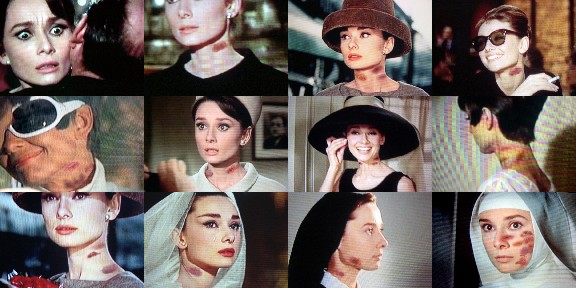
I’m showing new work. Some is from a lot of different shows but also new work that hasn’t even been seen in New York or L.A. And none of the work has been seen here. There’s a piece called A Passion for Audrey, which is Audrey Hepburn in every movie but with hickies on that beautiful neck. I alter film knowledge—that’s basically what my work is about, the film business and film knowledge.

How’d that start?

I started doing it because I needed a still from one of my own movies that I didn’t have. So I thought, How can I get this? Can I take it off the video, on the TV screen? And it worked, but in an arty, weird way. Then I became like a bad publicist looking for movie stills that would never be released as movie stills. I went so far into that that I did a series called “The Marks,” which is just the marks on the floor that actors have to hit. I focus on stills of details you’re not allowed to see in a movie—the opposite.

And then my writing career, I’ve always—you know, everything I do is about writing. My artwork—I think it up before I do it. I write it, basically. My books I write. My movies I write. My journalism I write. My standup I write. So basically, I’m a writer. And every morning I’ve gotta think of something, and every afternoon I sell it. That’s my life. I start at 8 a.m. every day; I get up at 6. I walk out to get my papers, and every morning the cable car goes by at the exact moment I step out the door; it’s really to the second.

That says a lot about our cable car system and your schedule.

I love the cable car system. They are my mode of transportation. I live in a Rice-A-Roni commercial. It’s like a joke. It’s like getting on the Tilt-A-Whirl to go to the store. They’re great! I love the—I take the bus here everywhere. I think the transportation system here is really good. I said that and it was on a blog: Has John Waters lost his mind? I can say I want one of the Manson family paroled [Leslie Van Houten, who was convicted for murdering Leno and Rosemary LaBianca; she’s another of the role models in Waters’s book], and it didn’t cause controversy. But saying that the public transportation was good—there was outrage!

Let’s switch gears. I know you have a very fashionable reputation.

I understand the ludicrousness of fashion. I follow fashion as I follow art, and I follow it as an art form. I think everybody can have a fashion if you even find it in the gutter. I don’t think it has to be about money. Matter of fact, if you’re young and buy designer clothes, you’re an idiot. It’s for over forty; you need help then. But at twenty, if you’re spending money on designer clothes, it’s ridiculous. You should be wearing the things they copy.

What are some of your favorite places to go here, your favorite bar and restaurants.

My favorite bar is Delirium. And I love lots of restaurants. I like Zuni, which my friend Billy West started; he’s long dead. I like Foreign Cinema, Range—I go out to eat all the time here. It’s a great food town.

Tell me what you think about the art scene here. Any favored artists?

Brett Reichman and Vincent Fecteau are my two favorite local artists, and they’re also very good friends of mine. Of course, I love Rena, and I’m a big fan of Jeffrey Fraenkel—talk about a beautiful gallery, beautiful catalogues, great stuff there. I think you have great film festivals here. I’ve also been active with Frameline, the gay film festival.

Culturally it’s a great town, but at the same time there are crazy people here, too. You can go down and walk through the Tenderloin and think, Wow, this is like what the Bowery was in the forties. It’s amazing to me. But it doesn’t seem scary to me at all. But I don’t scare easily. The Mission I like, but the mission is very different—and it’s completely mixed. I’m for gay and straights mixed together; I’m not so much for separation of anything. This used to be a gayer town in a weird way. When I was here when I was young, South of Market was 100 percent gay. When you don’t know who’s what, that seems much more exciting to me.

Let’s talk about your book, Role Models. What inspired you to write it?

I wrote the Tennessee Williams essay when his memoirs were released. New Directions [Publishing] asked me if I’d write the introduction, and that gave me the idea. It’s telling my story through others.

Why are role models important?

Everybody has role models. Basically I’m always really interested in people’s lives that have survived with grace and dignity and have had a life more extreme than mine has ever been. That’s what the book’s about. And every person in my book I do look up to for different reasons, for many complicated reasons, and there’s not an easy answer to any of the people I bring up. I mean like Madalyn Murray O’Hair who couldn’t be more unlikable in a way even though I believe in what she fought for—taking prayer out of the school. But people forget what she was like. Certainly Leslie Van Houten, which is the only chapter in the book that is completely serious. There’s no fair answer to her situation. I’m fascinated by someone who did something so terrible when she was young and is now so obviously better and rehabilitated and beyond it. But what is the fair answer? To me, if you’re raised in a system of jail where for forty years they tell you there is a system you can participate in to get parole, and you have done every possible thing for forty years and they admit it—she didn’t get life without parole. But I understand the victims, what they say. But they’re talking from a personal viewpoint and I’m talking from society’s viewpoint. And those are two completely different things.

Is there anyone you haven’t met whom you’d like to meet?

Mostly they’re dead. I have met many of my role models. David Plante, the writer—not people who are instantly famous. I’ve never met Ned Rorem, the classical musician and diarist—people like that. I’m not dieing to meet someone who’s a big famous rock star. Around here, I want to meet the guy who wrote that book [points to Oh, The Glory of it All]—Sean Wilsey.

A LARGE AND DISTINCTIVELY whole-body Waters laugh followed, and then soon it was time to quit this questful Q&A. But even after the door closed and the goodbyes were waved, I indulged thedelight of the wickedly wonderful Waters worldview just a moment more. And instead of taking a taxi to my next destination, I caught the coming cable car.

This interview originally appeared in the Nob Hill Gazette.
Louise Bourgeois's "The Feeding"

The vast ouvre of internationally recognized and legendary artist Louise Bourgeois, now 98, has always been personal, often autobiographical. The artist has also worked in a wide variety of media. This show of newer work at Gallery Paule Anglim, titled “Mother and Child” (on view through June 12), features both aspects. On view are sculptures, verse, gouache drawings, and prints focused on motherhood, sexuality, birthing, the female power to create, aging, and dying. With these, then, Bourgeois also continues her career-long attention to the experience of being a housewife/mother, further establishing her as one of our most important feminist artists.

Bourgeouis’s work can tilt towards heavy-handedness, particularly when it engages in overly literal, sometimes gruesome, dipictions of pain and fear. That is not a problem here; in fact, quite the opposite.

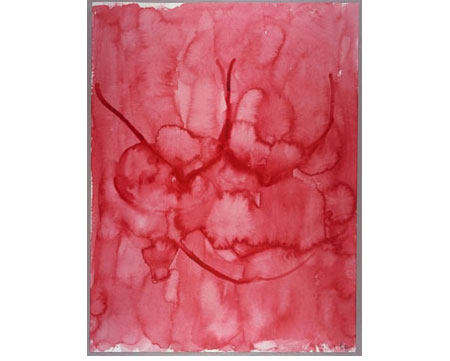
The gems of the show are the thirteen gouache drawings. This is particularly interesting given the imagery – graphic birthing scenes and nudes of pregnant women that depict the fetus in utero – and the fact that they are all painted in blood red on a flat white background. Crudely painted to the point of being almost abstract, with edges blurred by the watery gouache, they are approachable and, somehow, sad. They reveal themselves slowly; from the forms emerge a baby’s head from between two legs, and oversized breasts. These are solitary women, swollen and alone. Slightly more abstract, and quiet, are the two medium-size bronze sculptures. From Bourgeois’s “Echo” series, these are casts of sweaters that had been soaked and stuffed; they’re both painted white. Hinting at the human figure, the sagging, drooping forms poetically speak to emptiness, aging, and death.

Intimate, shocking, scary, viseral, beautiful, Bourgeois here succeeds as only someone with years of experience at her craft and art, and a long life of intense and moving experiences fully felt, is able. She gets to you where it counts.

David Michael Smith's "King George III"

 
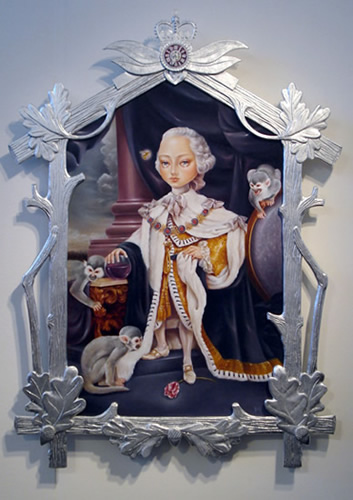
From the moment I first saw SF-based artist David Michael Smith‘s work at Scott Richards Contemporary Art a month or so ago, I was smitten. I had the chance to see this latest creation, King George III, at the SF Fine Art Fair, and I liked it so well that I was inspired to create this new section so I could talk about it: my pick of the week.
Smith draws on historic personalities, pop culture, and symbolism to add rich (often creepy or dark) narrative to his beautifully rendered, almost surreal paintings. Note, for this work, he also made the frame and constructed the clock.
Here is Smith’s full description of this painting as stated on gallery Website: This painting depicts King George III, the third British monarch from the House of Hanover. By all accounts a well-intentioned, pious, and judicious king, he suffered in later life from recurrent and, eventually, permanent mental illness. This is generally supposed to have been the result of the blood disease porphyria.
One of the symptoms of porphyria is a purple discoloration of urine during an attack. The painting is saturated with the color purple and the glass bowl under his right hand is full of a purple liquid. The pillar behind him is made of porphyry (derived from the same Greek word, meaning “purple pigment,” from which the disease is named) as is the clock face set into the frame. I’ve included symbols of madness in the painting including a hornet and a tulip and the looming storm on the horizon.
King George III kept a menagerie of exotic animals at Kew Gardens and I’ve included the monkeys as a reference to them. As his life became more and more wretched due to his illness, he lived much of his later years as a prisoner in Windsor Castle, subjected to the harsh treatment of various doctors. I imagine he could have felt quite a kinship with these creatures, ripped from the normalcy of their lives and put behind bars.

Davide Coltro's "Living Shrouds," detail

One hundred black-and-white portraits, with an emphasis toward the black end of the scale, repetitively line the walls of this solo exhibition by new media Milan-based artist Davide Coltro (on view April 1 through May15, 2010). Each work measures 16-by-13 inches and is encased in a plastic sleeve; the sole break in the lineup: a screen, similar in size to the portraits, playing a random feed of hundreds of these images, here brightly colored, melding slowly into each other, one after the next.

The portraits, which feature Coltro’s friends or people he’s met, were created with a standard office photocopier; the subject laid his or her head on the machine. This accounts for the mostly three-quarter or full profiles, with only a few head-on shots. The method also explains the darkness of the images and that everything surrounding the face is black.

To create the continually morphing screen feed, the artist uses a proprietary algorithm he wrote, which resizes, colors, and combines the portraits. The screen recalls and further pushes the work, “[Systems],” featured in the artist’s first exhibition at Wolfe Contemporary (2007), which focused on landscape. Again, Coltro approaches a traditional genre through his lens of unique technology.
While the printouts serve to support the screen module, the combination works well as a whole. While the screen steadily presents a never-ending march of faces over time, the single portraits snaking the gallery walls offer the whole crowd, all at once. And both views upend the genre: whereas portraiture originally highlighted an individual’s uniqueness, set him or her apart, these streams of faces remind us that we are one of many. The xeroxing process, which renders a visual sameness, reinforces this . So stark, unflattering, and similarly produced are the images, beauty and status become a non-factor. The end result is one of equitability and unification.

The one off-putting aspect of the show is the plastic encasing of the images; wavy and reflective, it makes the portraits difficult to see. (It’s curious to learn that this display was insisted on by the artist.) But still, the show works. The flow of images is harmonious; the screen, especially, is mesmerizing. And, this is at its heart a conceptual piece; it is the idea we take with us. We are all a part of this, in it together. There’s a comfort in that.

This review originally ran in art, ltd magazine.

Ai Weiwei's "Snake Bag"

The Ai Weiwei show at Haines Gallery is important for many reasons, not all of which have to do with the specific work on view. Hailing from Beijing, Weiwei is at the forefront of the increasingly vibrant conversation the international art world is having about contemporary Asian art, especially that coming out of China. An activist and forceful critic of the Chinese government (he was beaten by the Chinese police last year and suffered life-threatening head injuries because of it), Weiwei’s art gives outsiders intimate insight into Chinese culture and current issues through the universal language of objects and concepts. His work also resonates within Western art history. Obvious influences and references can be made to Marcel Duchamp, Félix González-Torres, and Andy Warhol, and even contemporaries, such as Jeff Koons. (Also worth noting, similar to other mega-artists, Weiwei employs loads of assistants to transform his vision into form.)

Weiwei is a conceptual artist; the greater message of his pieces is not immediately evident. Where his work succeeds then is that it engages us to the point of curiosity. The pieces on show at Haines—all recent sculpture (2006–2010) of various mediums, including porcelain, marble, and canvas packs—are pretty, sometimes luscious, and simple. They are easy points of entry to sometimes difficult subjects.

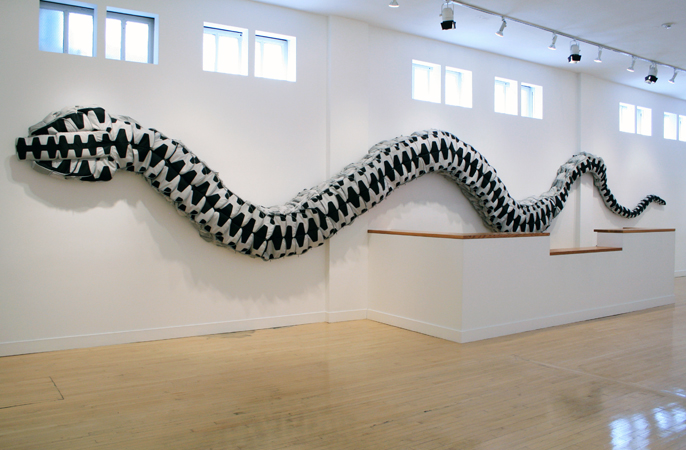
Perhaps most powerful—at almost sixty feet long, it has quite a presence—is Snake Bag, 2008, a series of 360 backpacks zippered together in the form of a serpent. The work is a memorial to the thousands of children who perished in the 2008 Sichuan Province earthquake; Weiwei holds the government responsible for the excessiveness of the death toll (it was this criticism that led to the police beatings). Kui Hua Zi (sunflower seeds), 2009, is another strong work. Comprising 550 pounds of porcelain seeds piled in a conical shape (it took twenty assistants more than a year to hand-make all the pieces), it’s a nod to the famine diet of peasants during Mao’s Great Leap Forward, which spanned 1959 to 1961. The work readily recalls Gonzalez-Torres’s candy piles, albeit appropriately relaying a slightly less generous twist. Of particular interest to the Bay Area is Owl Houses, 2010, a collection of ten hand-painted porcelain structures meant to be owl habitats. These were recently installed in the San Francisco Presidio to serve their sheltering purpose as part of “Presidio Habitats,” an on-site group exhibition that  runs through May 16, 2011.

This is the first major solo exhibition of Weiwei’s work on the West Coast. Go to see some lovely work, stay for the conversation.

This exhibition is on view until May 28, 2010.

Interact with the artist: Additionally, Haines Gallery has created an “Ai Weiwei at Haines Gallery” blog. It serves as a place where the public, artist, and gallery can interact. Questions and comments for Weiwei are encouraged; it’s a unique opportunity to interact directly with the artist. Go to: hainesgallery.wordpress.com.

Patrick Dintino's "Bubble Yum"

Patrick Dintino has created an artistic lens through which he looks at everything that interests him: consumer culture, news media, karma, advertising, endangered species, and now, leisure. The products of his process are mesmerizing spectrum paintings. He’s been making them for over ten years, and in his mind, he’s just begun. “I’m very much interested in color codes and how we react,” he explains. Every one of Dintino’s paintings features a series of vertical bands of various widths and colors; each strip blends into the next, forming hazy boundaries. From afar the works look airbrushed. They are not. Each is made by hand with a house-painting brush. “If you look close,” he says, “you’ll see brush marks, hair and dirt in there. I want these to challenge people about the idea or concept of painting.” The physical process of making the work is straightforward. “I go up and down, up and down until the colors blend.”

Dintino will research an idea for weeks or months before he commits it to canvas. “I get imagery from the Internet,” he says, pointing to a recent work, which will appear in his upcoming solo exhibition at San Francisco’s Andrea Schwartz Gallery. “I’ll have a concept—for this one I searched for ‘vacation’—and see what images pop up. I’ll sift through thousands of images and see what color vibrations speak to me.” Dintino notes that once a painting is started, he finishes it in one sitting. “I’m a control person,” he explains, “but in this type of painting, you can’t control; it’s a forced spontaneity. There is difficulty in combining colors, but I like that tension, that idea of a certain amount of clash. If it’s comfortable, then it becomes predictable. I want it to be a bit uncomfortable but beautiful at the same time.”

Though abstract, Dintino’s spectrum paintings each feature a distinct rhythm and narrative—a melody, he states. (He used to be a full-time musician.) And even though there is an engaging dis-ease in these works, they are meditative.

Dintino grew up in the Bay Area. He earned his undergrad and master’s degrees at California College of the Arts, where he now teaches painting. He began his artistic explorations in the Funk art tradition, turning trash into sculpture. This evolved into collage work, which he still does today. His material is mostly packaging or junk mail. “I like the idea that it’s delivered to my house,” he says with a mischievous smile. “I’m playing with that idea of information that’s delivered. I like taking information that’s supposed to go into the mind and distorting it, changing it and reflecting it back on itself.”

In its minimalist approach, Dintino’s work falls outside of current fashion. Although he doesn’t align himself in particular with any of his contemporaries, he notes having been influenced by Op art painters such as Bridget Riley, color field artists, à la Mark Rothko, and perceptualists, such as Robert Irwin and James Turrell. As is, Dintino’s efforts haven’t gone unnoticed. He was a 2002 SECA finalist, and is up again for the award this year; he was awarded a Pollock-Krasner Foundation Grant in 2004. Working out of his converted garage studio at his El Cerrito home, Dintino is free to clear his mind and mull over what lies behind the various tones, hues, and images we’re bombarded with. “I am distorting people’s views with these spectrum paintings, their perception of things,” he says. “That’s what’s driving this work.”

Patrick Dintino’s work will be featured in an upcoming solo show at Andrea Schwartz Gallery, in San Francisco, from June 16 – July 30, 2010.

This profile appears in the May/June issue of art, ltd magazine.

"Color & Color" Winter 2010 issue

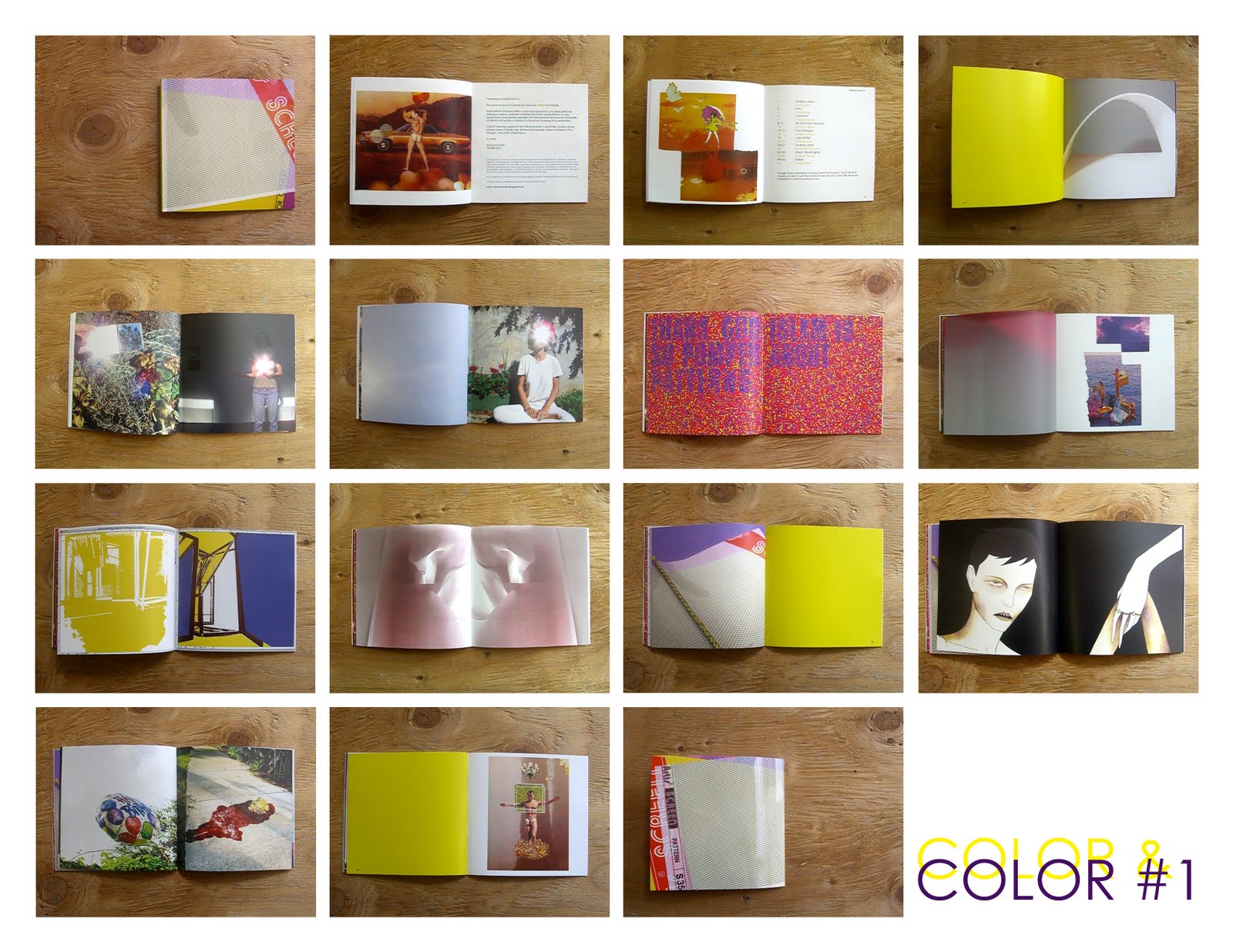
Going the DIY route and traveling in the well-tread Bay Area tradition of  artist book production—a la Hot & Cold and One Artist One Book, among many others—artists Amanda Curreri and Erik Scollon (both represented by SF–based Ping Pong Gallery) recently began co-curating and co-producing the seasonal publication Color & Color. The second/Winter (CC#1) issue has just been released; it’s forty-six pages feature work by Luke Butler, Audrey Hynes, Lindsay Jesse, Cybele Lyle, Ali Naschke-Messing, Nyeema Morgan, Paul Morgan, and Marci Washington. The common theme that runs between issues is (not surprisingly) color; specifically, each issue is “guided by the duality of two thematic colors.” This issue’s colors are yellow and purple. The first issue (CC#0), released last Fall, was based on orange and blue. 
Color & Color, as Curreri and Scollon explain online, “was conceived as a mobile venue in which to present new work of artists we respect and with whom we want to work. We hope that with each issue the publication can connect artists with new audiences and expanded dialogue.”  
The publication is available in print and digitally. More information and links to acquiring one or both issues can be found at the Color & Color site.

Design a site like this with WordPress.com
Get started