Several months back, I was ordering a cappuccino at SFMOMA’s new rooftop sculpture garden, and I noticed a dessert offering that uncannily resembled a Piet Mondrian painting. Another looked a lot like a Wayne Thiebaud cake. Looking closer, I saw that all of the desserts had ties to artwork.

“These are beautiful, and look delicious,” I thought. “I’ve never seen anything like this.”
And I was right; these unique sweets are the creation of resident pastry chef Caitlin Williams Freeman and can only be found in this singular location. And though the idea of making art-inspired treats came to Caitlin in a flash, the full-circle journey to this took a decade.

I sat down with Caitlin at the rooftop garden on a recent sunny day to discuss how she went from being a photography student at UC Santa Cruz and pastry shop counter girl to developing her own baking and pastry niche.

Caitlin Williams Freeman holding a Wayne Thiebaud-inspired cake; courtesy SFMOMA

Chérie Turner: Can you tell me about your art background?

Caitlin Williams Freeman: I was at school in Santa Cruz in the photography program, and we would come up here [to San Francisco] a lot to see various gallery shows. And we would always come to the museum. That’s when I first saw Wayne Thiebaud’s painting [Display Cakes], and I was captivated. I didn’t know what I wanted to do with it. I just really, really loved that one particular painting.

CT: And how’d you get started with baking?

CWF: In college, I worked at this pastry shop. I was just a counter girl, but I was so obsessed with pastries. Years later, I ended up meeting the woman [Megan Ray] who became my business partner.

She had just gotten laid off at a dot com and had never worked at a bakery. But she decided she wanted a cake shop, and so, the two of us were enthusiastic enough that we would just work all hours. We would do farmer’s markets. Then we were offered a space in the ferry building. That was October 2003.

Working at Miette [the cake shop] is how I met James [Freeman, owner of Blue Bottle Coffee]. He was my next-door neighbor at the Berkeley farmer’s market. It’s a long story–then in 2008, I sold my part of Miette; it was actually the same day James and I got married.

The Ellsworth Kelly ice-cream bar (with Kelly sculpture on rooftop garden in background)' courtesy SFMOMA

I took a few months off after that and made pastries for James, for Blue Bottle. I figured I’d do that for a while, and then I’d go do my own thing–open a pie shop or something. Shortly after that, the museum [SFMOMA] asked James to open a coffee shop here [at the rooftop garden].


I thought it was really cool, but I hadn’t really thought about any connections–but we were up here and suddenly I was like, this is the reason I’m a baker! Because I was obsessed with this painting in this building. We were in this meeting, and I grabbed James and said, “Can I make Thiebaud cakes here?” He said, “Sure!”

So that was the plan: I was going to make Thiebaud cakes in the place where I became inspired to become a baker. It felt so perfect. It had taken me ten years to get here, but it couldn’t have happened better if I had planned it.

CT: But you did more than just Thiebaud cakes.

CWF: Yes. To figure out what else I was going to make, I went and soaked in every piece of art that was on display and tried to figure out what to do. And it’s fun because, with the exception of the Thiebaud cake, which we always have on the menu whether or not the painting is hanging, we really keep the desserts limited to reflecting what’s actually on display in the museum. So when a new show comes up, we make a new dessert based on what will be showing.

CT: Can you talk about the process of coming up with new desserts?

CWF: It’s generally something I’m really inspired by. But you also have to be in tune with what are the popping pieces, the pieces you just can’t miss.

We have this Agnes Martin piece right now that we’re working on, but I really wonder, “Is anyone going to get this?” It’s such a subtle piece, and it’s such a subtle product that we made, and I think it’s just perfect and delicious. But I have no idea if people are going to connect to it. In that case, then, we try to come up with something that is interesting in another way. We have both the artistic angle and the food angle, so if we have something that’s a little more abstract, we can try to make it a more beguiling flavor combo.
I’ve been inspired in many different ways. Like the Mondrian cake. I distinctly remember going past the Mondrian painting, and I kept thinking, “What can I even do with that?” I knew I had to do something, but I didn’t know what.

The Piet Mondrian cake; courtesy SFMOMA

Then I happened to be looking through this old cookbook of Victorian cakes. There’s this old cake called the Battenberg cake; it’s an old British cake. When you cut it, it’s a checkerboard. And I was like, “There it is!” So that ended up happening by finding a cake that was an inspiration and seeing the structure and figuring out how to turn it into art.

We’ve also been really liking these do-it-yourself art/dessert pieces, like the Richard Serra piece. We’re just about to do Alexander Calder build-your-own mobile cookies.

CT: So, what is your overall general approach to developing these desserts?

CWF: We keep two worlds in mind [art and food] and see where they can cross over. Some are really obvious, like the Thiebaud and [Richard] Diebenkorn, and those we feel like we have to have because people can connect with them really easily. But I don’t ever want to recreate a piece of art. It’s our interpretation of it.
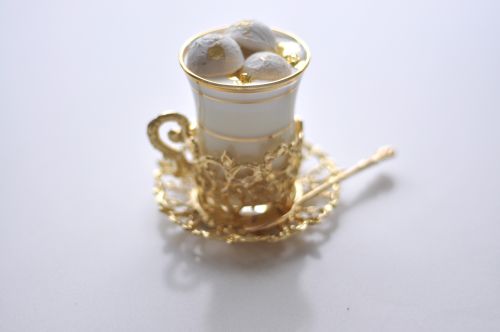
The Jeff Koons "Michael Jackson and Bubbles" dessert; courtesy SFMOMA
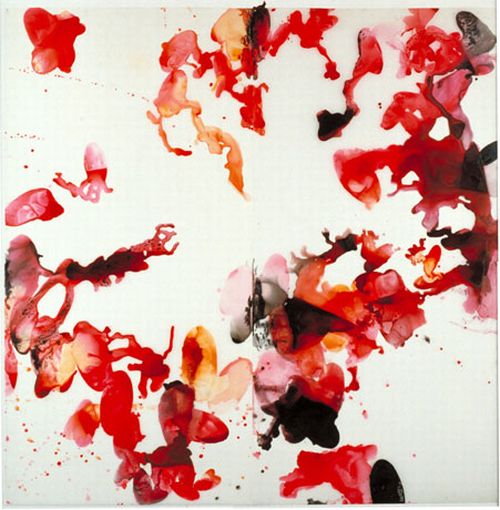
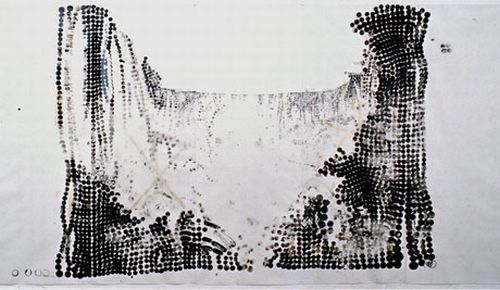
Ever since Bay Area painter Nellie King Solomon had her first solo show in San Francisco fresh out of graduate school in 2001, her work has met with positive reviews, even from the hard-to-please SF Chronicle art critic Kenneth Baker. (She’s also a three-time SECA nominee, up again for the award this year.) The final words of his glowing appraisal of that first show also issued up a challenge that many shared: “Her show is a powerful debut that will be hard for her to follow.” Solomon laughs about the gauntlet Baker threw. Her reaction? “I was like, you do not know who you’re messing with.” Almost a decade later, the work is stronger than ever.

As Is, 2001, by Nellie King Solomon; courtesy Nellie King Solomon

Solomon makes luscious, ephemeral large-scale abstract paintings on Mylar, addressing issues of space and environment, control and movement. They are created in her light-filled Hunter’s Point studio, on a table using handmade tools or sometimes just gravity to maneuver the paint. The imperfect surface contributes to the creation. Her early works were bright and fluid; puddles and rivulets meandered over the opaque surface resulting in meditative, organic paintings. On some, oval marks stamped with one of her homemade wooden tools, are also evident, harkening back to the point at which Solomon started her artistic journey–with the dot.

Solomon’s path to painting was indirect. Raised in San Francisco by an architect father and philosopher/dancer/writer mother, she’s known the creative life since birth. But it wasn’t clear until she’d already pursued several different avenues, including sustainable agriculture and architecture, that painting would be her primary focus. The decision to pursue art–Solomon earned a master’s of fine arts degree from California College of the Arts–coincided with a shift in momentum. “The reason for the dot was to stop traveling. Every two years I would leave some city and move to another. I needed to stop. The line, which was architecture, was also travel; so I took it away. I was in dots for four years before I touched representation and then another four years before I touched color. Then it moved to these ovals because I wanted a little bit of speed, but I still wanted it to stay slow.”

Niagara, 2000, by Nellie King Solomon; courtesy Nellie King Solomon

With this new work, Solomon is beginning to move. Whereas past paintings were almost self-created by the undulations of her work surface, in these, Solomon is the primary guiding force. A common feature throughout are large, thick rings that don’t quite close; the shape is created with a graceful full-body gesture, a nod to Solomon’s early training as a dancer. “I have hidden that strong arm behind my back for a long time,” she explains. “I’m just letting it come out. That’s one reason I work so large. I want it to be to some degree out of my control. If it’s too big for me to be able to handle, it keeps me from getting glib. It keeps me a little scared.” Solomon’s increased boldness is also evident in her changing palette. Pretty pinks, reds, and yellows of the past are replaced by toxic neon oranges and magentas and dark browns, black, green, and blue mixed with glitter; the edges, caked with soda-ash, have a corroded texture. The influence of Solomon’s interest in the environment, and the increasing degradation of it, is increasingly obvious. Gone are the delicate niceties of early work; these paintings are brave, brazen, and intense.

Boom Bloom, 2008, by Nellie King Solomon; courtesy Brian Gross Fine Art

“I always knew I had something to say,” says Solomon, reflecting back over her career to date. “I just didn’t know what I was going to say. But I knew that nobody was going to do it if I didn’t. I feel like I’m just getting started.”

This is not about Dave Eggers, the best-selling author and founder/editor of McSweeney’s. Nor is it about David Byrne, the bike-rack designer and lead singer of the Talking Heads. This is about visual art and the two-man show that currently features work by both Eggers and Byrne at San Francisco’s Electric Works (on show through August 21).

Exhibition view of work by Dave Eggers

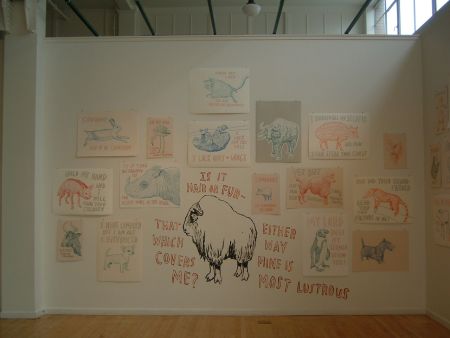
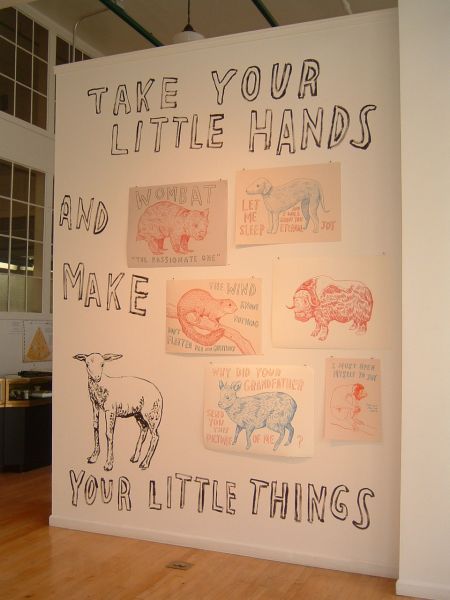
The first, and last, impression of this show is delight, with a dose of idiosyncrasy. It’s a good summer offering: light and witty, even quirky hip. Eggers’s contributions take up the larger space of the gallery, while Byrne’s work is featured in the smaller side-room. The work shares a clean aesthetic; both present drawings on paper (Eggers uses China marker, Byrnes, graphite) that incorporate use of text. Eggers’ space also features the same words and images painted large on the walls. Color is limited — black, white, orangey-red, and grey-blue.

Exhibition view of work by Dave Eggers

This is Eggers first solo art exhibition, and it’s a nice start. But this is not the first time Eggers has made visual art (though this his most recent work; all pieces are 2010). He studied painting and art history at the University of Illinois and worked as an illustrator, cartoonist, and designer before switching over to the written word; he didn’t think he could make art a career.
Each piece in the show features a detailed drawing of an animal against a blank white or tan of the paper surrounded by text; the animal images are based on old photos, and the text is Eggers’ idea of what that animal might be thinking. Appropriately, the animals’ personalities are introverted, standoffish, or a little sad. The artist’s graphic/illustrative influences are clear; the uncluttered, bold layout with large lettering is reminiscent of political propaganda posters — nature illustrations meet Shepard Fairey.

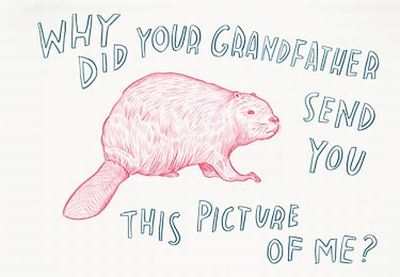
Why Did Your Grandfather Send You This Picture Of Me? by Dave Eggers; Photo courtesy SF Electric Works

The works on paper are hung all over, a loose salon style, and broken up by the large wall works. Animals are everywhere. A beaver poses the question: “Why did your grandfather send you this picture of me?” A rhino states: “It is time you thanked us for deeds done in thy name.” A bull notes: “You will never have a successful long-distance relationship.” And a bat boldly says: “Go to the city in your car.” In several cases, the same text is used with a different animal or the same animal is paired with different text. The phrases are humorous, at times poignant or advisory, though several do feel like inside jokes or personal observations we’re not let in on.

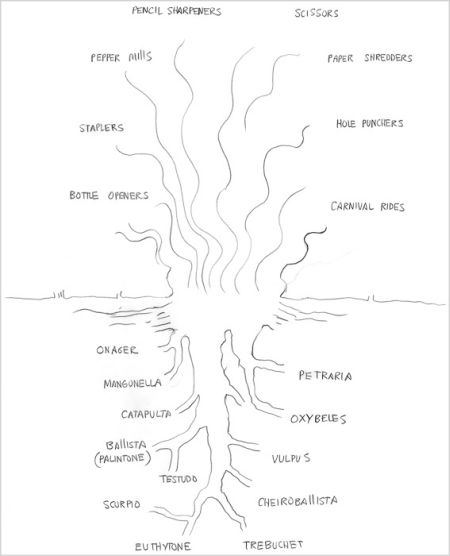
Military Technology by David Byrne; courtesy SF Electric Works

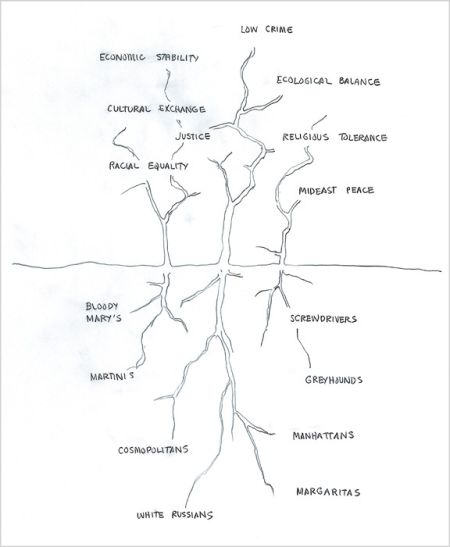
This is not David Byrne’s first art exhibition; he has been showing artwork since 1990 (in a group show held in Tokyo). Featured here are several drawings from his early 2000s “Arboretum” series (which was, incidentally, featured in a book by the same name published by McSweeney’s). As the series’ title suggests, the images (mostly) connote trees; they are very simple line drawings that only hint at the form. Fittingly, image serves only as structure for what are really diagrams (also on view are a bar graph and a Venn diagram); a word is written on each branch and root. In them, Byrne humorously, smartly traces the connection or flow from one idea to another, often seemingly unrelated, idea — unless you’re Byrne’s imagination. In his words, Byrne says:

Drawing/diagrams (mostly) in the form of trees, which both elucidate and obfuscate the roots of contemporary phenomena and terminology. Sort of like borrowing the evolutionary tree format and applying it to other, often incompatible, things. In doing so a kind of humorous disjointed scientism of the mind heaves into view.

The Influence of Mixed Drinks by David Byrne; courtesy SF Electric Works

In The Performing Arts, roots of One-Man Show, Dance Theater, Revival, Fringe and other performance-associated designations grow branches of Bankers, Designers, Bureaucrats, Politicians, Career Military, and other professions. The Influence of Mixed Drinks features roots of various popular cocktails and branches of idyllic world situations: Racial Equality, Religious Tolerance, Mideast Peace, and the like.
The shows together provide insight into the creative thought processes of these contemporary cultural influencers.

"A Girl Named Peaches" by Jill Gallenstein

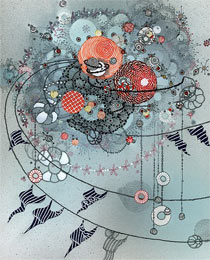
Linear and organic structures complement each other in this two-person show of sculpture and works on paper (on view through September 11, 2010, at Johansson Projects in Oakland). There is a shared lightness to the works, giving the exhibition an overall ethereal, meditative feel. The exhibition comprises two sculptures by Jana Flynn — one wall mounted and the other a site-specific, floor-to-ceiling work that spans the back of the gallery — and several ink-on-paper works of various sizes by Jill Gallenstein.

Flynn’s creations come out of the craft of string art (think geometry class projects, gone huge, complex, and elaborate). She arranges arrays of strings, each their own color: Each same-length piece of string is fixed at either end; termination points are at equal intervals. Each array of strings, then, effectively creates a plane.  Flynn interweaves these planes, shaping and bending space. The works are at once delicate in their transparency while also being formidable — the taut lines make firm boundaries. (Of note is that these very precise, measured works are created improvisationally; they are not preplanned.)

Juxtaposed next to these are highly detailed and gorgeously colored works by Gallenstein. Rounded objects, starbursts, and other creations from the artist’s imagination group together, string out, and sometimes regroup across or down the paper; the backgrounds often feature subtle washes of color which enhance the atmosphere. The intricacy of these works cannot be overemphasized; they are stunningly rendered, each shape decorated with dots and lines to the tiniest degree. Up close, they are a wonder of obsessive attention; far away, they present beautiful, fluid compositions in bright, dramatic palettes.

Considering these two artists together, Flynn’s sculptures bring out the taut structure in Gallenstein’s work; Gallenstein’s seemingly amorphous works highlight the lyric aspects of the three-dimensional pieces. If these works hold their own individually, seeing them side-by-side mutually enhances their impact — a reminder of how the experience of an artwork is profoundly affected by its surroundings.

"Pitch" by Timothy Nolan

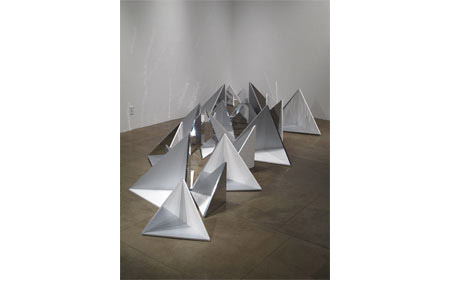
In his solo exhibition at Marx & Zavattero (on view through August 21, 2010), Los Angeles-based artist Timothy Nolan delivers contemplative sculpture that is all clean geometric forms, a subtle palate of silver, black, gray, and white, and various surface treatments – mirrored, reflective, flat. Nolan continues his investigation of patterns, repetition, and systems, both made and natural. The work easily draws the viewer into the complexity encompassed, including the exploration of visual perception and construction of illusory versus real space.

Evident throughout is the influence of minimalism and cubism; the artist is also inspired by craft and op art. The exhibition features floor and wall sculpture as well as works of silver metallic paper on panel and other two-dimensional pieces. The centerpiece – both literally, as it takes up a large space within the gallery, and figuratively; it’s enchanting – is the twenty-foot-long Pitch. Comprising more than twenty triangular pieces of various sizes, with several of the surfaces mirrored and reflecting off of each other, the work evolves into endless shards and crystalline structures, elegantly getting to the heart of Nolan’s interests. In the wall sculpture, “Stack” – which is also made up of a series of over twenty non-identical hard-edged shapes, these composed of printed vinyl on aluminum – geometric shapes in five gray-scale hues also play with our comprehension of light and shadow and the shaping of space; the piece appears to be more three-dimensional than its flat surfaces really are.

While Nolan’s artwork overall is hard-edged and calculated in appearance, it’s not cold. This is meditative work that we not only see but experience.

I came across a quote from John Waters in the current issue of Juxtapose magazine that neatly threaded together three things in a way I hadn’t previously realized: What I loved most about his last solo exhibition (titled “Rush” at Rena Bransten Gallery, San Francisco, May 27 through July 10), one of the primary draws I have to looking at art, and why I’m also so drawn to the current solo exhibition of work by Maira Kalman, titled “Various Illuminations (of a Crazy World),” at the Contemporary Jewish Museum (CMJ) in San Francisco.

Waters says: “Art is exactly when there’s nothing there and only you can see it. If you go to art galleries all day and you really learn to see, when you walk home, at least for a couple of hours, you’ll see something on the street that will remind you of art. It fades; you have to go back to galleries. But then everything you see will look like art…”

John Waters, Pecker Still Life (4), 2010, chromogenic color print; Courtesy Rena Bransten Gallery

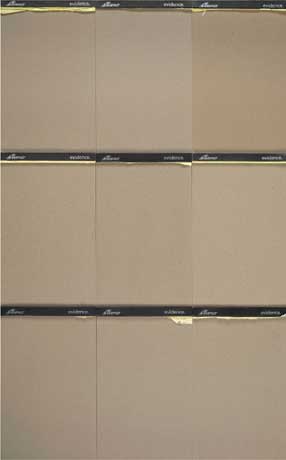
This is why I so loved Waters’s recent series of photographs, “Pecker Still Life,” which debuted in “Rush” and depicted unremarkable sights behind the scenes of movie filming — bits of the crew’s everyday life — as well as the piece “Shooting Script”, a photo of a grid of nine pads of yellow lined paper with all the pages ripped off and only the cardboard left. These are common objects with great stories.

New York artist Maira Kalman takes this elevating of the everyday even further: She’s turned just about anything in her world — from rubberbands, shoes, a candy bar, and a single pink present to hotel rooms, a found couch, or a dream — into artwork. “Basically I get paid to be myself,” Kalman says in a quote from one of the show catalog essays, “and for my imagination.” And what a joy.

Maira Kalman, Pink Package, 2004-5, gouache on paper; Courtesy of the artist and Julie Saul Gallery, New York

Kalman’s work is most familiar outside of the context of the fine art world. She’s long been an illustrator for the New Yorker — having created many covers — as well as twelve children’s books (most of which she either wrote or co-wrote), the first of which, Stay Up Late, was a collaboration with Talking Heads front-man David Byrne. She’s written and blogged for the New York Times, has worked on a set for Mark Morris and designed with Isaac Mizrahi and Kate Spade, among other projects. She is also a photographer and embroiderer. This, her first solo museum exhibition, is a retrospective covering thirty years of Kalman’s work and also includes an installation of objects from her home and studio; it premiered at the Institute of Contemporary Art at the University of Pennsylvania earlier this year, will be on show at the CMJ through October 26, and then travels to the Skirball Cultural Center in L.A. and The Jewish Museum in New York.

Installation detail; Contemporary Jewish Museum, San Francisco

Kalman is not a formally trained illustrator or painter, but that’s not to say her pieces are uninformed by the art world. The work is layered with cultural and art historical references from Matisse and Chagall, Dadaism, Surrealism, and Futurism. Fashion, travel, and design also figure greatly. In addition to illustration, an arena Kalman has had a profound impact on is design; she was very influential in the work of her husband Tibor Kalman (now deceased), who founded M&Co, a firm that is credited with changing the world of contemporary graphic design. Among other projects, M&Co created Bennetton’s Color magazine.

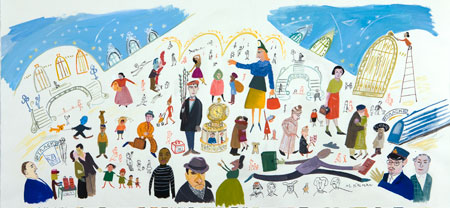
Maira Kalman, New York, Grand Central Station, 1999, gouache and ink on paper; Courtesy of the artist and Julie Saul Gallery, New York

Kalman’s work, however, does have an outsider art quality — quirky, unique, absurd and highly imaginative. Figures and objects are not rendered precisely but possess personality and a distinct loveable quality. And, they are often funny. “Maira Kalman,” says curator Hiroko Tanaka in a catalog brochure of the artist’s 1989 exhibition at Ginza Art Space in Tokyo, “your pictures are so crazy that everyone wants to hug them.”

Kalman’s work engenders great affection, no doubt. Her honest representations hit their mark. In another of the essay’s for this show, Kalman is quoted describing a painting she did of Le Corbusier’s kitchen sink. She says her intension was that it be “an earnest and loving presentation of something I fell in love with.”

This is the very heart of Kalman’s work, and why we heart it so much. Not only do we share her love of what she presents to us, we begin to see the love-worthy bits of life’s art we unattentively pass by every day.

"Wildwood" by Nemo Gould

Don’t let the title of the exhibition derail you: this is not a show of devices aimed at doing evil. It is a superb display of the intersection among art, mechanics, and whimsical beings. Finely crafted, imaginatively assembled, and possessing a balance of humor and insight, the work in this three-person exhibition is unique and eclectic.  “Machinations” (on show through August 21, 2010) features the art of Jeremy Mayer, Nemo Gould, and Benjamin Cowden — all Oakland-based — in this new gallery’s second exhibition.

The common thread of these works is the assembling, reassigning, and recycling of found or archaic objects — often mechanical — to examine or explore creative inquiries or comment on the human condition. Evident is an interest in robotics and the inner workings of man-made systems. (Not surprisingly, all three artists presented work at the recent Maker Faire at the San Mateo County Event Center during May.) Though sharing these similarities, the expressions are different. Mayer exclusively uses antique typewriter parts to creative human forms; he does not solder, weld, or glue any of the pieces, they are only reassembled. The three works here are extraordinarily detailed, beautiful, but the clear standout here is the graceful lifesized female figure Nude IV, Delilah.

Gould presents dioramas, large-scale figures, and wall-mounted pieces, including a green-backlit octopus creature, partially made out of a guitar, which is thus fittingly titled Acoustapus. The materials used to create these intricate and often funny works vary widely — wood, spare parts, a lens, a thermometer conduit, and much more have found their way in. Not everyone finds his work amusing, however. Gould created the larger-than-life, anatomically correct robot sculpture that met with neighborhood controversy in 2004 when best-selling author Robert Mailer Anderson and wife Nicola Miner — daughter of Oracle co-founder, Robert Miner — displayed it in front of their Pacific Heights home. The topics Gould explores range widely, from commentary on the struggling artist, to oil spills, the monkeys who died in space experiments, and his obsession with the aforementioned octopuses.

The four kinetic sculptures created by Cowden are clean and sleek, elegant forms. Using gears and other interworking mechanical parts with miniature human figures or fabricated body parts, the work examines the human experience. A Series of Arbitrary but Passionate Decisions points to the uncontrollable nature of life; Eating my Cake and Having it Too, which features a disembodied (fake) tongue and lollypop, examines that oft-quoted phrase.

This is tinkering taken to the level of sublime. This show serves as a reminder that, with ingenuity, curiosity, imagination, and the care of craftsmanship, our junk really can transformed into treasure.

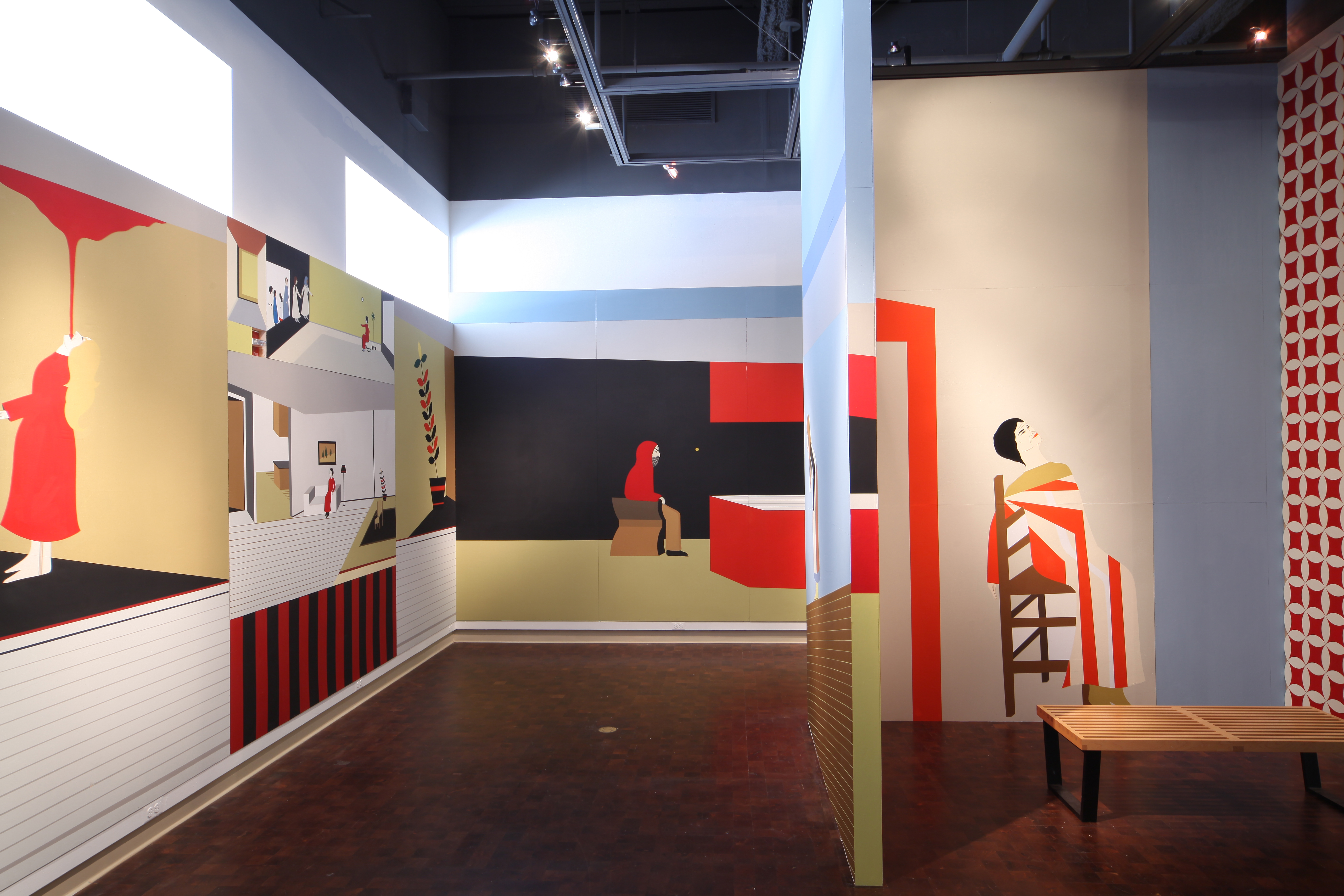
Installation view of Clare Rojas's solo exhibition at SF Museum of Craft and Folk Art; courtesy SFMCFA

San Francisco neo-folk artist Clare Rojas expands her visual range in this pivotal show of new work, which dominates the intimate space of this small museum. This is a powerful, twistedly delightful exhibition. It further adds to the artist’s growing stature as one of the Bay Area’s most celebrated and prolific contemporary artists. In addition to this, her first solo museum show, Rojas’s work is also currently featured in a two-person exhibition with Barry McGee at the Bolinas Museum of Art, and, last April, the SF Arts Commission installed a commissioned work by her at the City’s international airport.
 
In keeping with past work, this show is bright and graphic. The flatness of the work references Rojas’s printmaking past; the influences of folk art, outsider art, street art, cartooning, illustration, and quilting remain strong. Rojas is rightly associated with the area’s “lowbrow” Mission School, which also encompasses artists McGee, Chris Johanson, and Margaret Kilgallen, among others. Comparisons among the artists can readily be drawn.
 
But Rojas is not simply a product of influences. Her voice, iconography, and message are distinctive and evolving. In this show, Rojas presents both smaller works, which are hung salon-style along one wall, and then numerous enormous works that cover the rest of the walls from floor to ceiling. Also on view is an amusing video, “Manipulation,” that Rojas contributed to with animation.
 
Throughout, the artist continues her references to home-life with figurative narratives that are often bizarre, verging on disturbing; a primary topic is gender/feminism. In one large-scale work, three women look to the sky, two expelling an upflowing substance from their mouths, the other from her eyes. In another, three male figures ascend a striped ramp/tongue that leads to a woman’s open mouth.
 
New here the artist also presents almost completely abstracted scenes, though references to the home remain; another larger-than-life piece is a minimalist home interior. Exploring formal uses of line, perspective, color, and composition, Rojas’s depiction of this comfort zone gets a little queasy. One high point of the exhibition is a huge “wall quilt” made up of numerous geometric panels, each painted one color, and arranged in a way that recalls childhood parquetry block designs; this surrounds a central seated female figure.
 
A critique that has been leveled at Rojas’ work is that it drifts toward decorative simplicity. Now, no. It has decorative elements that make it likable, just not too likeable. It pushes far beyond becoming vapid or ingratiating. Colors, shapes, and patterns clash in challenging, dissonant ways; there is a not-quite-right-ness that keeps us fully engaged. It is, indeed, the decorativeness that provides the hook; we stick around to feel the story.

In a 2004 New York Times review of Rojas’s solo show at Deitch Projects, critic Roberta Smith ended with the upbeat, “. . . this show generally brims with promise.” Clare Rojas is making good on that promise.

This review was originally published at Visual Art Source.

Four galleries in San Francisco have teamed up and given curatorial freedom and unlimited access to their racks to four artists tasked to create one four-part group exhibition. This superb mega-show is called: “They Knew What They Wanted”. And it’s a rare change-up to the typically less inspiring multi-artist shows that occupy gallery space during this, the art world’s slow season. It’s also helping to bring together the city’s ever burgeoning art scene.

Detail of show curated by Katy Grannan at Fraenkel Gallery; courtesy Fraenkel Gallery

Roughly a year ago, Jeffrey Fraenkel, owner of his eponymous and highly regarded photography gallery, dreamed up the idea of a collaborative summer project involving other galleries. He teamed up with internationally renown Berggruen Gallery and two newer, highly contemporary galleries, Ratio 3 and Altman Siegel and developed “They Knew What They Wanted.” The show spans all four spaces. Each gallery’s part is curated by one of their own artists — Robert Bechtle for Berggruen, Katy Grannan for Fraenkel, Jordan Kantor for Ratio 3, and Shannon Ebner (the only non-SF artist; she’s from L.A.) for Altman Siegel.

DETAIL of show curated by Jordan Kantor at Ratio 3; courtesy Ratio 3

“This truly was a collaborative effort,” says Frish Brandt, director of Fraenkel. She also notes that this was a case study in gallery cross-pollination, as a means to strengthen the area’s visual art community and relationships among galleries. Quoting a favorite borrowed phrase, she says, “I’ve always said, ‘It takes a village.'” So successful has this project been, both from a planning as well as a results standpoint, Brandt notes that there is interest in future collaborations.

I’ll admit, when I first learned about this show, I thought it might suffer from being gimmicky, too hip and clever. I was wrong. After I saw the first show, I couldn’t wait to see the second. My enthusiasm only increased as I made my way to galleries three and four. One of the original show titles was something along the lines of “Treasure Hunt.” While I’m happy that got nixed, it does rightly point to the searching, journey, discovery elements of this project.

From gallery to gallery, there’s the joy of finding stellar not often or rarely seen pictures and sculptures from artists famous, emerging, and little or unknown — and spanning a large swath of time — such as: anonymous, E.J. Bellocq, Vija Celmins, Lee Friedlander, Adam Fuss, Maureen Gallace, Edward Muybridge, Trevor Plagen, Ed Ruscha, Rachel Whiteread, Sara Vanderbeek, Bernd and Hilla Becher, Charlie Harper, Matt Keegan, Los Carpinteros, Henry Wessel, Barry McGee, Tom McKinley, Manuel Neri, Mitzi Pederson, Robert Rauschenberg, Will Rogan, Iran Do Espirito Santo, Garth Weiser, and others, including the artist/curators themselves.

The installments are further enhanced by unique curating, expressing the individual personalities or creative investigations of the artists. “It’s as much about the artists as it is about the shows,” observes Brandt. We’re also reminded the role curating plays in how art is perceived; new context provides a fresh take — the experience of an artwork is always partially a product of the environment. “Everything has its absolute right place in relationship to itself and the work that it is in proximity to,” says Ebner on this subject. “Each artwork possesses a universe and so determining where it belongs in relationship to all of the other universes around it is a very satisfying problem.”

Painting from show curated by Robert Bechtle at Berggruen Gallery, Tom McKinley, Pool House, 2008, courtesy Berggruen Gallery

So, puzzling through the curatorial dynamic of each show presents another layer of pleasures. At Freankel, Grannan presents clumps of coherence that play off each other in strangely humorous ways. “It’s ineffable,” observes Brandt about Grannan’s chapter. “It has a certain energy – -messy and chaotic.” An energy akin to that of the subjects in the photographs Grannan makes. Similar rhythm can be found in Kantor’s contribution. He started with key works and built small groups around each. The show holds together with a subtle narrative that one feels rather than tells; Kantor attributes that cohesion to the fact that all of the works were ones that appeal to his taste. More directly emulating his artistic style, Bechtle’s show features almost exclusively landscape, many depicting everyday life. “I included many artists who I admire,” he says, “and added others I wasn’t familiar with.” Much of the curating process was intuitive, by the seat of his pants, he says.

Ebner’s creation has the feel of a singular installation. “I did not really set out with too much criteria,” she explains, “but more of a vague sense that I wanted the works selected for the show to possess a kind of quality or affect.

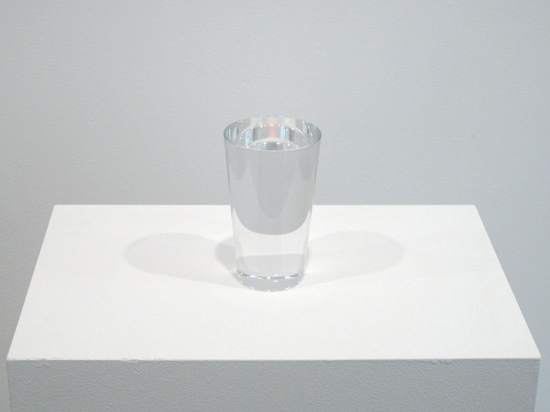
Sculpture from show curated by Shannon Ebner at Alman Siegel, Iran Do Espirito Santo, Water Glass 2, courtesy Altman Siegel, SF

“I was looking to see if there are ways to select and juxtapose artworks so that what they mean or say or do as a fixed identity is constantly being called into question,” Ebner continues. “A good example of this might be Iran’s water glass [Iran Do Espirito Santo’s Water Glass 2] and how, because it is a solid form made of crystal, it creates the illusion that it is a liquid, a glass always full. When you take a liquid and make it a solid, but still have it appear as what we expect it to be, you are really asking us to think about all of reality as a series of inquiries and/or doubts.”

“They Knew What They Wanted” is like great summer reading. Fun, liberating, and with just the right amount of depth and momentum; you not want to stop until you reach the end. It also leaves you hoping that there will be a new release next summer.

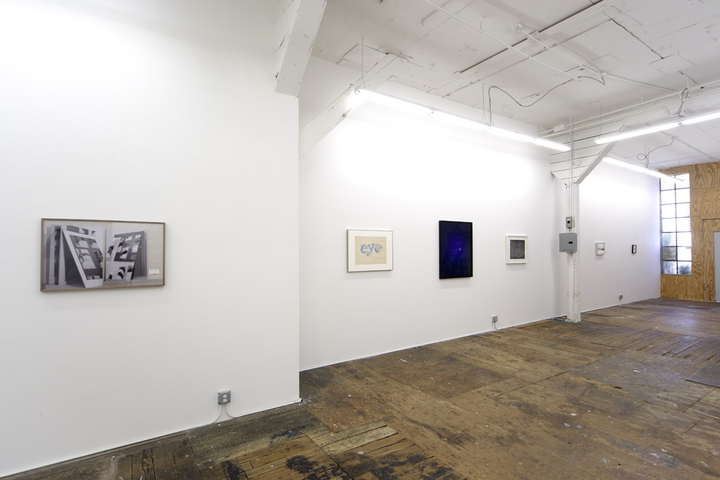
Detail of show curated by Shannon Ebner at Altman Siegel, courtesy Altman Siegel, SF

This exhibition closes August 13.

"Shooting Script" by John Waters

I was excited to see the solo exhibition at Rena Bransten Gallery of work by John Waters (on show through July 10). I’ve seen a lot of Waters’s creations online and in print (and, like most, am much more familiar with his movies than his artwork), but this was my first experience of them in person. I liked them, some surprising much.

Most of Waters’s artwork has some connection to film; he often alters movie stills, making them much more darkly humorous than the original. Those are fun. But even better are the works that show the poetic mundaneness of filmmaking, the everyday stuff that’s really great to look at and provides us outsiders an insider peek into that mysteriously magical world of movies (apparently, it’s not as glamorous as you might imagine). Though I love the “Pecker” images, a series of photos taken on the set of Waters’s 1998 movie by that name (note that while many of the pieces on show in this exhibition have been previously shown in galleries in New York and L.A., this series makes its debut here), the piece that I revisited several times and return to in my memory often now is the one featured here, Shooting Script.

So simply, it gives us sense of how much goes into moviemaking; all the pages that had occupied those pads used up. Our imagination fills with all of the notes, directions, revisions, re-revisions that may have been on those sheets. Those nine pieces of blank cardboard (arranged so neatly; this is an organized process), fringed on top by all those little shredded scraps of paper—one with a small bit of writing still left—resonate with the all the activity dictated on what are likely now crumpled yellow balls in the trash. The whole process relayed in a grid of the remnants of dime-store notepads.

Design a site like this with WordPress.com
Get started