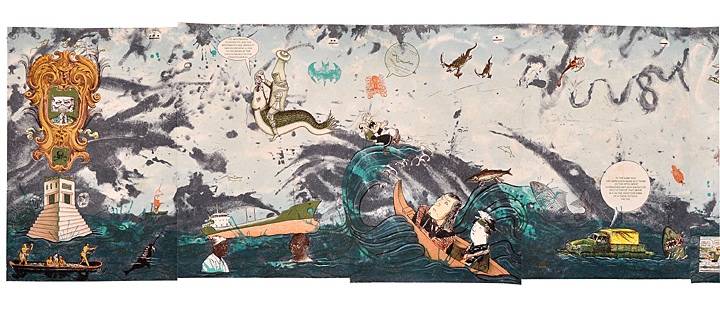
Enrique Chagoya's "Illegal Alien’s Guide to the Concept of Relative Surplus Value" will be offered in the silent auction at Vernissage

This Thursday, May 13: Vernissage, the MFA preview party and fundraiser for the SF Art Institute. Highlights include: live music by legendary Studio 13 Jass Band; guided private tours by some of the area’s finest curators (see list below); a silent auction featuring original fine art by SFAI alumni notables, including Nicole Buffett (BFA 01, MFA 04), Omar Chacon (MFA 04), Enrique Chagoya (BFA 84), and William Wiley (BFA 60, MFA 62); and the opportunity to be the first to experience the work of a next generation of emerging artists coming out of one of the nation’s most prestigious and forward-thinking art schools. The exhibition features work in a variety of media by approximately 100 graduating MFA students. Vernissage also presents the unique opportunity to meet and discuss with the artists. Additional information and purchase tickets at: http://bit.ly/cR2vp6.
Details
Where: Herbst Pavilion at Fort Mason (Marina Boulevard and Buchanan Street)
When: 6 p.m.  Patron tours with special curatorial guests; 7 p.m. Cocktail buffet / mingle with artists / silent auction / entertainment
Curtors offering private tours: Apsara DiQuinzio, Assistant Curator of Painting and Sculpture, SFMOMA; Rudolf Frieling, Curator of Media Arts, SFMOMA; Gary Garrels, Elise S. Haas Senior Curator of Painting and Sculpture, SFMOMA; Betti-Sue Hertz, Director of Visual Arts, Yerba Buena Center for the Arts; Hanru Hou, Director of Exhibitions and Galleries, SFAI; Robert Flynn Johnson, Curator Emeritus, Achenbach Foundation for Graphic Arts, Fine Arts Museums of San Francisco; Julio Cesar Morales, Adjunct Curator, Yerba Buena Center for the Arts; Jeannene Przyblyski, Dean of Academic Affairs, SFAI; Dominic Willsdon, Leanne and George Roberts Curator of Education and Public Programs, SFMOMA; and John Zarobell, Assistant Curator of Collections, Exhibitions, and Commissions, SFMOMA. 

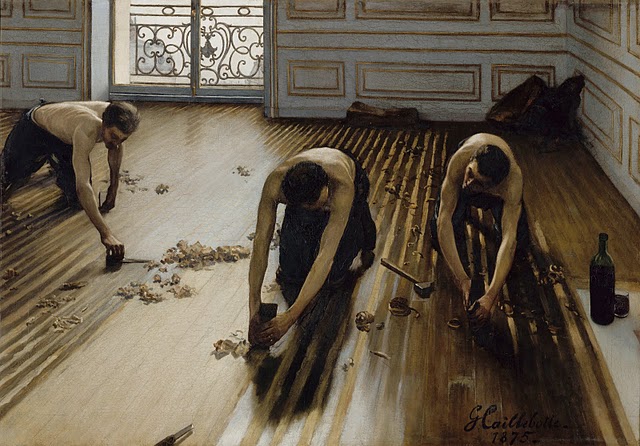
Gustave Caillebotte's "The Floor Scrapers"

Sit with this for a moment: beginning this late spring through January 2011, over two hundred iconic French Impressionist, Postimpressionist, Realist, and Naturalist paintings will be on show at San Francisco’s de Young Museum. And these works will never be seen again in such quantity outside of their home, the Musée d’Orsay in Paris.
Opening May 22 (and running through September 6) is “Birth of Impressionism,” which will feature about half the works and focus on Paris around 1874, when the first exhibition of Impressionist paintings took place. “There was a preponderance of different styles,” says  Director of the Fine Arts Museums of San Francisco John Buchanan, “all at once and all in one city.”
Almost immediately following (opening September 25 and running through January 18, 2011) is the exhibition “Van Gogh, Gauguin, Cezanne, and Beyond,” featuring Postimpression-ist work by the greatest masters of the genre. The de Young is the only venue in the world to get both shows.
How’d we get so lucky? It’s all about passion and good relationships. But first some background. The Musée d’Orsay is home to the world’s most comprehensive collection of nineteenth century French art, including Impressionist and Postimpressionist work, by design. Housed in what was originally a train station (note: the architect who transformed it into the museum, the renowned Gae Aulenti, is also responsible for San Francisco’s Asian Art Museum), created in 1900 for the Paris International Exhibition, the museum was launched in 1986. Its mission is to highlight Western art from 1848 to 1914. Its collection was formed by consolidating the best pieces from this period from the Louvre, Jeu de Paume, and the Modern Art Museum in Paris, as well as generous gifts from private parties. Many of the works coming to San Francisco were originally in the collection of Gustave Caillebotte; a painter himself (his stunning painting The Floor Scrapers will be on show in the first exhibition), he was also a man of great financial means. This allowed him to be an early collector of work by fellow artists. Interestingly as well, several paintings are making a return, having also been shown in San Francisco at the Panama Pacific exhibition of 1915.
In anticipation of its twenty-fifth anniversary next year, the d’Orsay is undergoing a major refurbishment. “The current director, Guy Cogeval, is a professional and personal friend of mine,” says Buchanan. “He asked if I wanted to make an exhibition with him.” Cogeval and Buchanan—who has a great love of nineteenth century French art and culture—met on several occasions to plan the show: two exhibitions emerged. And to that, Buchanan simply said: “I think we should do both.”
Viewers can anticipate what amounts to the rare experience of art history books come to life. The first exhibition highlights works by over forty artists, including such visionary masters as Edgar Degas, Frederic Bazille, Édouard Manet, Claude Monet, Alfred Sisley, Pierre-Auguste Renoir, and Gustav Courbet. Highlights include: Degas’s The Dancing Lesson (1873–1876) and Racehorses Before the Stands (1866–1868), Monet’s Saint-Lazare Station (1877) and Rue Montorquei, Paris (1878), and Pierre Puvi de Chavannes’s Young Girls on the Edge of the Sea (1879), among so many others. Buchanan points out that he is particularly excited about the numerous fine Manets that will be here—there will be eleven, ranging from 1865 to 1882. “He was a great Naturalist,” Buchanan says, “yet he was close friends with the Impressionists. His work was influenced by seventeenth century Spanish paintings. He was the first truly modern artist.” Particularly, Buchanan singles out The Fife Player (1866). “We make direct contact with a real human being,” he says of the painting’s subject. “He’s gazing directly at us.” Another greatly anticipated work is what many of us know as “Whistler’s Mother,” American expatriate James Abbott McNeill Whistler’s Arrangement in Gray and Black, no. 1 (1871). “It shows Realist and Naturalist tendencies,” Buchanan says. “And the influence of Japanese art.”
Running concurrent to “Birth of Impressionism” is “Impressionist Paris: City of Light,” at the de Young’s sister venue, the Legion of Honor (June 5 through September 26). Featuring over 180 prints, photographs, paintings, and books, it will add further context to the main exhibition.
Following, the “Van Gogh, Gauguin, Cezanne, and Beyond” exhibition features 120 works focusing on late Impressionist masterpieces, as well as Pointillist paintings by such masters as Georges Seurat and Paul Signac. Some of what we can look forward to: Vincent van Gogh’s Starry Night over the Rhone (1888), Portrait of the Artist with the Yellow Christ (1889) by Paul Gauguin, and Seurat’s The Circus (1891).
“This is a huge moment for those of us who love France and French art,” Buchanan concludes. “It’s like stepping into an art history book of late nineteenth century France.”

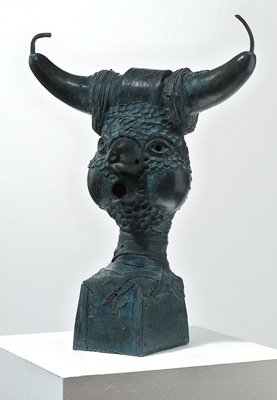
Thomas Campbell's "Der"

Yar is a nautical term for “ready,” or “quick and agile.” Being so, Thomas Campbell’s current show, which bears the term as its title, is appropriately named. It’s of the now, and ready in abundance; there are almost thirty works on show. Not overfull, the quantity is in synch with the lively color and ebullient movement of these works. They’re fun, whimsical, and detailed. This show is quick and agile, moving deftly through a variety of materials and forms: bronze sculpture, acrylic, spray-paint, wood cut-out sculpture, sewn fabric, gouache, gourds, prints.
The maritime reference is also fitting; Campbell’s work comes out of surfer/skateboarder culture (he lives in the small coastal town of Bonny Doon, outside of Santa Cruz). He is aligned with fellow “Beautiful Looser” (referencing the groundbreaking exhibition and now documentary film) artists, such as Barry McGee, Chris Johanson, and Mike Mills. Comparisons can also be made to artist Mike Shine, who also resides in a rural coastal town, Bolinas. With them he shares a graphic, bold, illustrative aesthetic. Also common, giving a nod to the graffiti/urban art scene, as well as recalling the 1960s rock posters by Wes Wilson, is the incorporation of words featuring stylized lettering. And like all of these artists, this work moves beyond its initial hit of jubilance, hipster trendiness, and humor (some work of this genre fails to get past this).
The work here is precisely executed and demonstrates a confident and rich use of color, pattern, narrative, form and composition. What points best to this are the two works that stray the most, but are perhaps the best in show: the two bronzes, Charles and Der. ared down to the blue-black color of the metal, each presents a single character. They demonstrate Campbell’s ability to edit and engage formally, seriously, and retain voice and vision; it’s yar.

William Wiley's "Durango Dexter and the Dolphins"

Just about one year ago, Bay Area musician, writer, and now visual artist Sonny Smith set out on a highly ambitious project: conceive of one hundred bands and/or musicians, coordinate over ninety artists to create album covers for the fictitious musical acts’ fictitious 45s, write and record the two hundred songs represented by these albums (A sides and B sides), and write the (mostly) fake musicians’ personas (Smith also included his own band, the Sunsets, in the mix). And he did it. The culmination of the effort is on view at Gallery 16 (through May 28).

Numerous well-known artists—William Wiley and Ed Ruscha, Tucker Nichols, Brion Nuda Rosch, Alice Shaw, and Chris Duncan—as well as Smith and lesser known names created albums. Hanging alongside many of them are the musician bios, which are most often humorous and engaging. Additionally, standing out among the crowd, there is the life-size jukebox, made by Smith, that plays the very real songs he created and recorded.

To be expected, the range of the artwork is huge: style (some appear professionally rendered while others show the hand of craft; some are tight and detailed, others are loose), media (drawing, painting, sewing), and tone (many are outright funny; none are terribly serious), and, yes, quality. What the show lacks in formal consistency of the visual work, however, it makes up with cleverness, wit, and multidimensionality—it’s wonderful, well developed satire. There is depth beyond the novelty, due in large part to the way Smith is exploring collaborating across media, and with so many artists; its greatest merit is the well-rounded exploration of imagination by merging visual, musical, and literary elements. And it’s also a lot of fun.
This exhibition is on view until May 28, 2010

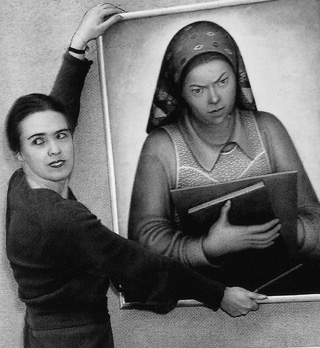
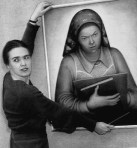
Grace McCann Morley

If you haven’t gotten swept up in the exuberance of celebratory zeal emanating from the San Francisco Museum of Modern Art (SFMOMA), it’s time. The museum is utilizing the occasion of its seventy-fifth anniversary to look back on itself. In doing so, it provides us the opportunity to get a better sense of how rich and influential this art institution is, and has been since its inception in 1935.
The umbrella tagline for all events associated with the anniversary, “75 Years of Looking Forward,” couldn’t be more appropriate when describing SFMOMA, beginning from day one with the appointment of Grace L. McCann Morley as the first director. She set a tone for the museum that resonates to this day.
Born in 1900, Morley was raised in the Bay Area. Her early academic training was in language. She earned a master’s degree in French from Cal Berkeley and went on to become a teacher—one of the primary professions educated women pursued at that time. As fortuitous opportunity would have it, she was asked to also teach art history, which led to Morley studying Museumology at Harvard University for a summer. Out of this influential department—it was then a new field of study—came a whole generation of museum curators and administrators. Morley went on to become a curator at the Cincinnati Museum of Art and then director of what was then the San Francisco Museum of Art. 
Morley’s forward-looking museum philosophy positioned the institution as a community and educational venue. At the time, most museums were aimed at scholars, serving more as research institutes to the already initiated and repositories of precious objects. And typically those objects were old, already indoctrinated into the cannon of art history. Opportunities to see contemporary work were few. SFMOMA was only the second museum in the country to focus on art of the time; MOMA New York was the first having opened just six years previous, in 1929.
Morley’s populist view led her to offer a huge variety of exhibitions; she interspersed traditional art with more challenging work. Her belief was that she would offer something for everyone and entice people to stretch their art-appreciation boundaries. She also began to offer educational lectures and classes.
Reactions to her efforts varied to the extreme. While researching the current exhibitions, the curatorial staff unearthed a stash of hate mail, which spoke out against her showing unconventional and nontraditional styles, such as Surrealism, Dada, and Cubism. At the other end of the spectrum, on the final day of the hugely popular Pablo Picasso retrospective in 1940, an adamant crowd of over 1,300 visitors refused to leave when the museum was closing; they stayed until they were done absorbing the magnificent show. Morley inspired passions that no doubt matched her own; something everyone would agree on is that she was unwaveringly dedicated. For example, working with a very limited budget and a tiny staff, the museum presented 75 to 100 exhibitions per year for the first five years (in comparison, the museum today puts on 30 to 35, in a larger space, with a larger budget and much larger staff).
Over time it would become increasingly evident that the strong-willed and determined Morley was keyed in to the pulse of the rapidly changing art world. During Morley’s tenure, many artists who would become seminal figures received their first solo exhibitions at SFMOMA, including Arshile Gorky, Clyfford Still, Jackson Pollock, Mark Rothko, and Robert Motherwell. That eye for emerging talent continues today; SFMOMA has also been the first museum venue to show Edward Ruscha, Matthew Barney, Jeff Koons, and Olafur Eliasson. Under Morley, the museum became the first to create a television show; run in the 1950s, it was the first television programming to focus on art. This was just one more creative and innovative way she brought art to the masses.
The museum has ever since been on the forefront of utilizing and embracing media and technology. It was, in 1987, the first to establish a media arts department, and with the creation in 1994 of the Interactive Educational Technologies program, SFMOMA has remained a leader in developing computer based, interactive educational features on art.  
Grace Morley led the museum until 1958. She earned the deep respect of the art world and general public the world over. On the occasion of the museum’s twentieth anniversary, she was featured in Time magazine. She also worked as a consultant for UNESCO.  From SFMOMA, she moved to India to help set up the National Museum there; Morley remained in India until her death in 1985.
Her legacy lives on in San Francisco. In addition to the many influential initiatives already mentioned, Morley is responsible for starting the museum’s permanent collection (it had no holdings when she began, which makes her ambitious and prolific exhibition programming all the more impressive), and making a commitment to supporting and showing the work of regional artists.
The current exhibitions, featuring in large part selections from SFMOMA’s outstanding permanent collection, give us all a unique glimpse at the history of the museum as well as an opportunity to understand, through experience, the innovative and progressive vision that began with Morley and continues to the present. The vibrant and inspiring dialog continues, and it’s open to us all.

Special thanks to Kara Kirk whose research and thesis project provided many of the facts and information on Grace McCann Morley included here.

This story appeared in the May issue of the Nob Hill Gazette.
The SF Center for the Book (SFCB) will host its annual fundraiser/silent auction/cocktail party April 27. Early bidding on unique book art works by over fifty established and emerging artists will run 6 to 7; open bidding takes place 7 to 8:30 p.m. Works include artists’ books, letterpress editions, posters, and related objects by such artists as Charles Hobson, Peter and Donna Thomas, Macy Chadwick, Prudy Kohler, Peter Linenthal, Linda Connor, Sas Colby, Carl Dern, Rory Golden, and Sevilla Granger, among many others.
SFCB fosters the art of books and bookmaking through hands-on workshops, exhibitions, education, and residencies.
Tickets $75 (preview hour); $20 (advance general admission)/$25 (general admission at the door); buy online at Brown Paper Tickets.

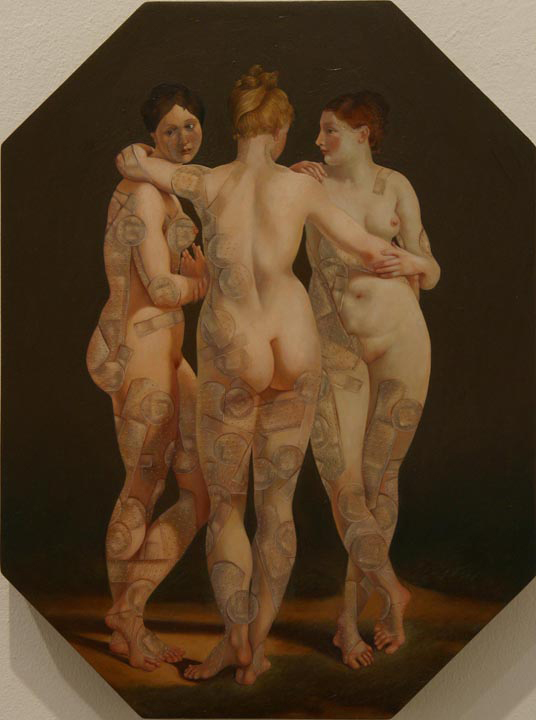
"The Three Graces" by Lucy Gaylord-Lindholm

This review of Lucy Gaylord-Lindholm’s current solo exhibition recently appeared on Visual Art Source:

Enchanting, strange and impeccably painted, the series of new oil paintings by Bay Area artist Lucy Gaylord-Lindholm are wonderfully enticing, presenting a multi-layered universe that continues to unfold. The thirteen detailed works that comprise the exhibition are small, ranging in size from 17.5-by-13 inches to 11.5-by-9 inches. They are designed to create an intimate viewing experience.
A romantic evening landscape is intruded on by an enormous structure, or perhaps it is a creature made of haphazardly arranged pieces of lumber and fronted by the head of what appears to be a bird. Finely rendered portraits morph into a tangle of string. Gaylord-Lindholm’s paintings have a classic, centuries-old feel, drawing on traditional subjects and the genres of landscape, still life, portraiture, and the figure, with a heavy dose of surrealism.
In Three Graces the famous mythological trio is depicted nude and voluptuous in its traditional grouping. The middle figure faces away while the other two have their faces exposed to the viewer; here, however, the nudes are variously covered in larger-than-life Band-Aids – the adhesive strips appear on multiple occasions in this body of work. And, unlike most portrayals where the women interact only with each other, here the figure on the left, Aglaea, goddess of beauty, stares brazenly at the viewer, referencing the once-upon-a-time controversial frankness of Édouard Manet’s Olympia.
Gaylord-Lindholm draws ideas and imagery primarily from art history, pop culture, science, and fairy tales. “I’ve always been interested in the quirky or absurd,” the artist says in a recent interview, “portraying the impossible in a way that almost could be plausible.” From show to show, painting to painting, the imagery varies widely, but throughout, the palette is rich, the work tight and dramatic. And there is a commonly depicted idea: change, juxtaposing reality and the further reaches of our imagination, often drawing from a place of fear – disintegration of self, insanity, claustrophobia.
Untitled #2 is a portrait of a young girl, face forward, who stares into the middle ground, out toward us, but not at us. Her hair is dark brown and tied back, giving her a plain look; her clothing, which we see from the waist up, is a dark grey. She is against a solid darkish brown-green background. Below her neckline we can partially see through her to what’s beneath her skin: a small shadowy horse, mechanics, perhaps a spaceship. There is movement indicated toward the bottom and flowing to the right, as if a celestial storm is beginning to blow through her and will eventually fully expose her bizarre inner workings.
While these works are haunting, they are so gorgeously rendered and delightfully intricate, they play out like a dark comedy. And though completely odd, they have an internal logic that makes its own kind of sense; these paintings aren’t arbitrary. They approach the edge of absurdity without crossing over. We come away smiling and a bit more comfortable with the world’s uncertainty.

The FOR-SITE Foundation, partnering with the Presidio Trust, will present “Presidio Habitats,” a site-based art exhibition featuring work by eleven artists from around the world. It is the first of its kind at a National Park. The exhibition opens to the public May 16, 2010, and will be on view through May 15, 2011.
The common concept each artist worked with was to create a habitat for a specific animal that lives in the Presidio. Featured projects, which vary widely, are as follows:

Ai Weiwei’s Western Screech Owl Habitats
CEBRA’s Sculpture Habitat for the Gray Fox
Chadwick Studio’s Habitat for Anna’s Hummingbird
Fritz Haeg’s Snag Tower
Jensen Architects’s Patience
Amy Lambert’s Pollen Balls Project
Nathan Lynch’s Where is the Hare?
Mark Dion with Nitin Jayaswal’s Winged Defense
Philippe Becker Design’s Winged Wisdom
Surface Design’s A Habitat of Flight
Taalman Koch Architecture’s Owl Dome
Many educational and informational programs and displays accompany the exhibition including a 1,300-square-foot exhibition space by Ogrydziak / Prillinger Architects, which features all twenty-five proposals originally submitted (from which the eleven were chosen), interpretive materials, and artist models. This will be located across from the Presidio’s Log Cabin. Additional in-depth information is provided by signage at each site, as well as audio narrative that is accessible via cell phone. Also available is a free exhibition brochure featuring a map and summary information on the works and selected animals.. Finally, there will be a series of  lectures  featuring participating artists, natural resource specialists, and other professionals involved with art and the environment. The exhibition and related programs are free and open to the public.
To launch this unique undertaking, a full-day celebration will be held May 16. Complete information will be available at the FOR-SITE Foundation Website.


Robert Hudson installation at One Hawthorne

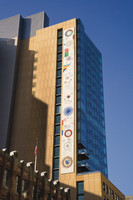
An enormous commission by renown Bay Area artist Robert Hudson was recently unveiled at One Hawthorne ( Hawthorne Lane and Howard Street in San Francisco). Measuring 145 feet tall by 12 feet wide, this exterior vertical mural comprises numerous porcelain enamel panels, on which is reproduced a series of 30-by-23-inch pen-and-ink drawings. The work spans sixteen floors.
In coordination with the unveiling, a solo exhibition of Hudson’s most recent drawings and sculpture is on show at Patricia Sweetow Gallery through May 15. Additionally, several of Hudson’s prints are currently on view at Crown Point Press as part of the group exhibition “California Impressions” (through May 1).

Several area galleries are moving, opening, or going away. Here’s the rundown.

The exhibition program at Steven Wolf Fine Arts is on hiatus while the gallery relocates to a new space in San Francisco. After seven years at 49 Geary Street, the gallery is looking for a space better suited to its exhibition program. During the pause Wolf will continue to blog and post updates about the gallery and the artists who work there.

LIMN Art Gallery is moving to 290 Townsend; the new space will open in May.

Sadly, Jack Hanley Gallery, which has had a been here since 1990, will be closing its SF location to focus on growing the programming at its New York location. The current group show, featuring a selection of new work by gallery artists and up until April 28, will be its last. Don’t miss it! Featured are many top emerging Bay Area artists, including 2009 SECA winner Tauba Auerbach, Chris Johanson, and Shaun O’Dell.  

Francis Mill and Michael Hackett, both of the recently closed Hackett Freedman Gallery, have launched Hackett-Mill. The duo’s new exhibition space at 201 Post will open April 13. Hackett-Mill will focus on works from the 1950s and 1960s with an emphasis on Bay Area Figurative, Abstract Expressionism, and American Modernism; it represents the estates of David Park, Emerson Woelffer, and Robert Schwartz and artists Manuel Neri, Frank Lobdell, and Raimonds Staprans.

Design a site like this with WordPress.com
Get started